No More Guesswork: The Principal’s Guide to Using Learning Intelligence for Better School Governance
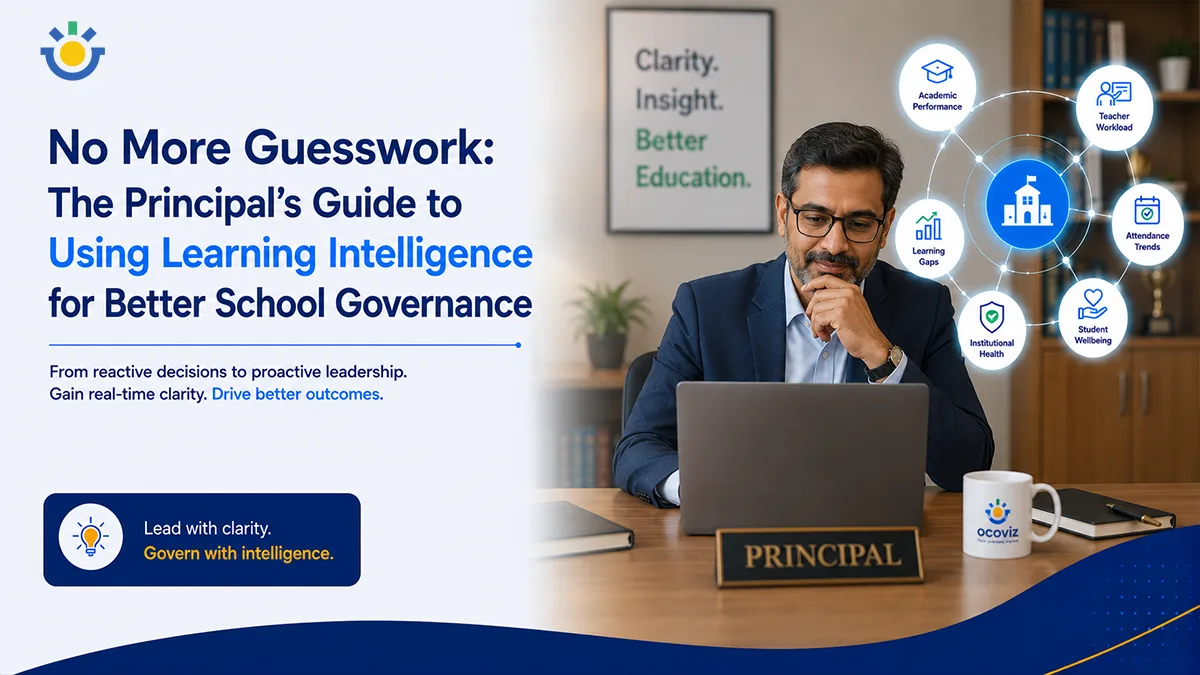
Step into the shoes of a school principal on any given Tuesday afternoon. A parent drops in unannounced, furiously claiming their child’s grade dropped because of a recent change in English teachers. Ten minutes later, a trustee calls asking for a definitive projection on fee collections versus operational costs for the upcoming quarter. Before you can look up the numbers, a coordinator asks to speak with you regarding a visible dip in middle-school student morale.
To answer any of these questions with absolute certainty, you have to initiate a familiar, exhausting chain reaction: print the logs, export the spreadsheets, schedule an emergency staff meeting, and wait for manually compiled reports.
By the time the data actually reaches your desk, it is already days old, heavily filtered, and prone to human bias.
Most principals are forced to govern their institutions in the dark, steering multi-million rupee infrastructures based on intuition, anecdotal feedback, and rearview-mirror metrics. But running an elite school shouldn't feel like a high-stakes guessing game. Your daily operational data shouldn't be trapped inside fragmented software interfaces or buried in filing cabinets; it should actively serve your leadership vision.
The Direct Answer
Principals can transition from reactive crisis management to strategic school governance by adopting Learning Intelligence systems that centralize administrative, academic, and operational workflows into a single executive dashboard. This real-time visibility allows leaders to instantly track teacher efficacy, student performance trends, and financial health, facilitating objective, data-driven institutional decisions.
Why Has Intuition-Based School Governance Reached Its Limit?
For decades, a principal's success was judged by their intuition—a seasoned instinct for keeping parents satisfied, teachers aligned, and students disciplined. However, as modern schools grow in complexity, relying entirely on "gut feeling" introduces significant operational vulnerabilities.
Anecdotal management leads to squeaky-wheel syndrome: the loudest parent gets the most attention, the most expressive teacher dictates policy, and silent, institutional friction points go completely unaddressed. When a school lacks a singular, unalterable baseline of factual data, governance inevitably becomes reactive. You find yourself constantly putting out operational fires rather than building a scalable, long-term educational legacy.
What is the Practical Architecture of a Learning Intelligence Dashboard?
Learning Intelligence doesn't mean adding another complex reporting chore to your team's plate. Instead, it acts as a passive collection matrix that transforms daily actions into intuitive visual analytics.
Legacy ERP Reports = Static, tabular lists of text, Requires manual data compilation, Fragmented by separate departments, Tells you what went wrong in June
Learning Intelligence Governance = Dynamic, visual health charts, Real-time, instant updates, Fully unified organizational views, Shows you what to fix by Friday
When daily operations are processed through an intelligent platform like Ocoviz, the administrative noise is automatically translated into macro-level insights tailored for executive leadership. With one glance at your dashboard, you can track cross-departmental attendance variations, evaluate fee amortization curves, and pinpoint which academic sections are falling behind on curriculum benchmarks—all without sending a single internal memo.
How Can Data Remove Bias from Teacher Performance Appraisals?
One of the most delicate challenges a principal faces is managing faculty performance objectively. Traditional appraisals often depend heavily on brief, annual classroom observations or subjective coordinator feedback, which can inadvertently foster workplace anxiety or perceived favoritism.
A Learning Intelligence platform introduces radical transparency. It tracks consistent, objective metrics over the entire academic year:
- How efficiently does a teacher complete syllabus checkpoints?
- What is the measurable learning growth rate of their students from diagnostic tests to final terms?
- How consistently do they update portal communications and gradebooks?
When appraisal conversations are anchored by verified data trends, they shift from stressful personal critiques into constructive, collaborative professional development sessions.
Can Better Governance Directly Lower Parent Attrition?
Parent dissatisfaction rarely stems from a single isolated incident; it builds gradually when families feel left out of their child's daily developmental arc.
When your leadership operates on a Learning Intelligence model, your communication strategy transforms completely. Instead of sending out mass, generic notifications, the system allows you to govern parent relations proactively. The platform identifies which families are drifting in engagement, enabling your team to step in with tailored interventions before frustration sets in, thereby safeguarding your school's local enrollment reputation.
Practical Takeaways
- Transition to an executive morning review: Spend the first ten minutes of your day checking a single, unified health dashboard rather than reading fragmented status emails.
- Enforce data-first problem identification: Establish a rule that any major operational issue brought to your desk must be accompanied by its verified system metric.
- Automate your board meeting presentations: Eliminate days of manual presentation preparation by exporting dynamic visual analytics directly from your core operating system.
- Implement mid-term curriculum velocity checks: Use automated tracking to compare actual lesson completion rates against your master academic calendar weeks before deadlines arrive.
Conclusion
True institutional governance isn't about controlling every minor detail; it is about having total visibility over the entire ecosystem. Upgrading your school's infrastructure to a comprehensive Learning Intelligence platform gives you the clarity required to lead with conviction. When you eliminate the exhausting guesswork from your daily routine, you unlock the mental freedom to focus on what truly defines a legendary principal: inspiring your faculty, cultivating community trust, and charting a bold future for your students.
Frequently Asked Questions
What exactly makes a Learning Intelligence dashboard different from standard ERP reports?
How much time does a principal need to invest daily to read these dashboards effectively?
Will moving our governance to a data-driven model make our school feel too cold or corporate?
How secure is this executive data view from unauthorized staff or outside eyes?
Can this system help us project our school's financial health and upcoming expenses?
How does a Learning Intelligence platform help during surprise government inspections or board audits?
What happens if a teacher objects to having their performance metrics tracked so closely?
Can we integrate our school's existing biometric attendance and security systems into this dashboard?
How long does it typically take to transition our administrative data from a legacy system to this new model?
Take Complete Control of Your Institutional Vision
Schedule an exclusive presentation to discover how Ocoviz replaces administrative guesswork with crystal-clear, actionable operational insights.
🚀 Book a Free Demo