Leading from the Front: Why School Principals Need to See Problems Before They Happen
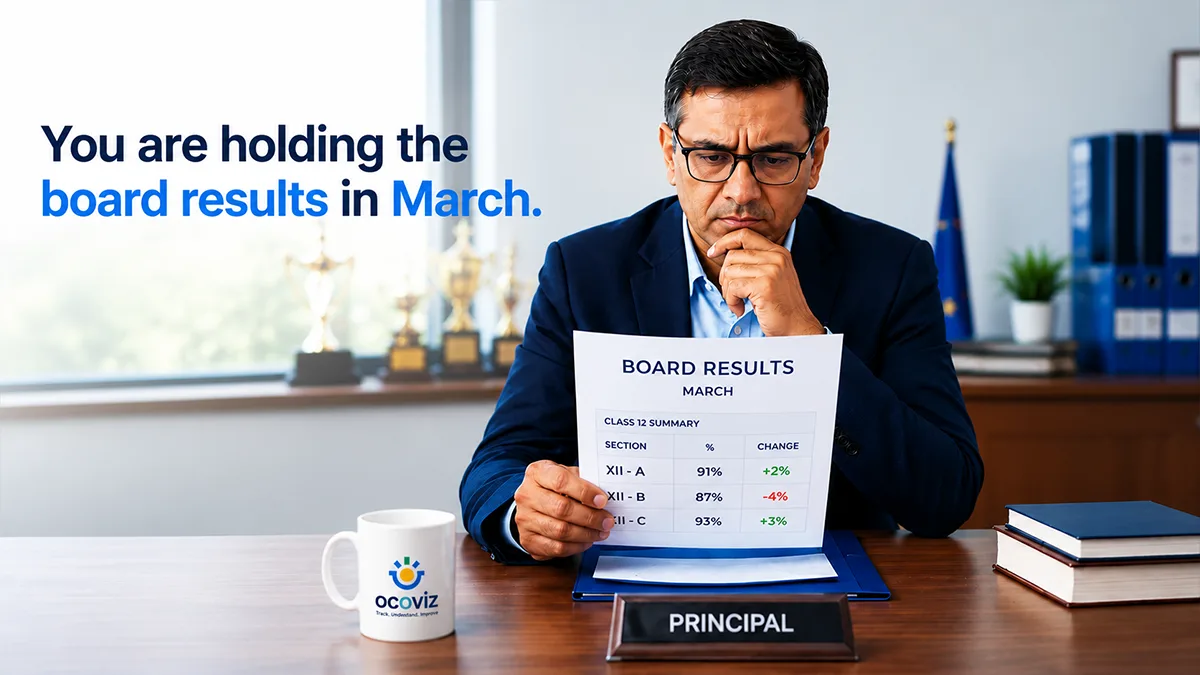
The March Surprise That Isn't a Surprise
Imagine you are sitting at your desk in March, holding the final board exam results. You open the file, look down the columns of names, and read the marks. Deep down, you already know what most of them will say. A good principal develops a strong feel for these things over the school year. You know who worked hard, who struggled, and which classes faced the biggest challenges.
But there is something else inside those numbers that no one in the building could have told you back in September. The true story of those final marks was actually finished by October.
The Class 12 section that dropped four percentage points did not fail in the exam hall. They did not lose those marks during the stressful weeks of final testing. Their drop started in the second week of the school term. It happened when a teacher quietly stopped pushing them to do better, and the students quietly stopped trying to catch up.
On the other side of the page, the two classes that got the highest marks in the school were decided early too. Their good habits were locked in during the very first month of school. By the time the final marks arrive on your desk in March, you are not reading a report that helps you make decisions. You are reading a report about things that are already over. It is like reading a medical report after the patient has already left.
This is the strange position that every serious school principal faces today. You are held fully responsible for final outcomes that you can only see after they have already happened.
Driving a School by Looking in the Rear-View Mirror
Think about the tools and reports your school actually gives you to lead with each month. The monthly test analysis? That is history. The attendance register? That is history too. The mid-term comparison notes, the parent complaint log, the comments a teacher writes in a student's diary—all of these are just a record of things that are already over.
Your entire dashboard points backward. Leading a school this way is exactly like trying to drive a car while only looking at the rear-view mirror. You can see exactly what you hit, but you cannot see what is coming up on the road ahead of you.
Good principals try to fix this by using their personal instincts. You walk up and down the corridors during lessons. You stand in the staffroom and listen to the teachers talk. You can sense when a specific classroom has gone flat or lost its energy long before any test score confirms it.
That human instinct is real, and it is incredibly valuable. But that instinct has a natural limit. It works beautifully when you run a small school with 200 students. You can know every face and every story. But that human instinct starts to break down when your school grows to 800, 1,000, or 2,000 students.
You cannot personally hold the daily progress of every single child, every classroom section, and every teacher in your head at the same time. Nobody can. As your school grows larger, the gap between what you are responsible for and what you can actually see grows wider every single day.
The Real Cost of Being Reactive
Because our tools look backward, our leadership style becomes reactive. This means we spend our days reacting to bad news instead of stopping it from happening.
You find out a whole group of students is weak only when the pre-board exam marks come back bad. You find out a teacher has stopped engaging with their lessons only when three different parents call your office to complain in the same week. You find out that students missed a foundational math step in Class 9 only when that gap causes them to fail a major concept in Class 10.
In every single case, by the time the bad news is loud enough to reach the principal's office, the best time to fix it has already passed. The cheap, easy window to help that student or guide that teacher has closed. You are left trying to fix a big crisis instead of managing a small bump.
The Shift That Changes What Leadership Means
Now, imagine a completely different way to run your school day. Imagine the exact same information about a struggling class arriving on your desk six weeks earlier.
We are not talking about a prettier graph or a colorful spreadsheet. You already have plenty of spreadsheets. A standard spreadsheet just shows you yesterday's news with brighter colors.
Instead, imagine that the system flags a dangerous pattern before the bad outcome even happens. Imagine receiving a simple note that says: This specific section is starting to bend the wrong way, and the drop started in these three specific classes. Or a note that says: This group of students is on track to perform poorly in science next term, but you still have a full three months left to change how the subject is taught.
This kind of system might tell you that a sudden dip in attendance in Class 8 matches a pattern that ended up causing high failure rates two years ago.
When you get that data early, your entire job changes. When you can see a bad result while it is still forming, leadership stops being about crisis management. It becomes what it was always supposed to be: active steering. You can step in to help a class that is six weeks away from a major problem, instead of spending your evening trying to comfort the parents of a child who has already failed.
You can put your best remedial teachers and school resources where the hard evidence shows they are needed most, rather than just giving help to the parent or teacher who complains the loudest in your office. You can walk into your next board meeting showing a positive direction for the future, rather than explaining a tragedy that already happened.
The difference between a good school and a truly great school is rarely the quality of the teaching on any single random day. The real difference is how early the school notices when something starts to go wrong—and whether the school notices it while there is still time left on the calendar to fix it.
See It While You Can Still Change It
This is the entire core idea behind having an intelligence layer in your school. It is not just another software system that records past events. It is a smart tool that reads the hidden patterns your daily registers miss. It tells you what is coming down the road while the school term is still yours to shape.
Your school already creates every single signal it needs to predict success or failure. The data is already there in the daily attendance, the weekly homework marks, and the behavior notes. The only real question is whether anyone in leadership gets to see those signals in time to make a difference.
✓ Stop waiting for final terms. Look at the direction a class is moving in during the first six weeks, not the last six weeks.
✓ Look for patterns, not just single marks. A single low test score might just be a bad day. A slow drop across three weeks means a student has checked out.
✓ Use data to guide your hallway walks. Use early alerts to know exactly which classrooms to visit today, making your physical presence count.
The Ocoviz Solution: This is exactly why we built Ocoviz. We did not want to create another digital filing cabinet that just stores old records. Ocoviz turns the daily data your school is already producing into clear foresight that you can act on today. It helps you see what your school's data is trying to tell you, while you still have the time to change the story.
Conclusion
As a principal, your ultimate goal is to guide your school toward a bright future, not just record its past. You cannot change a grade that has already been written on a final report card, but you can change the path a student is walking today. By trading your rear-view mirror for a clear view of the road ahead, you can stop managing school crises and start truly leading your school.
Frequently Asked Questions
Why are traditional school report cards not enough for principals?
What are the early warning signs that a school class is struggling?
How does an intelligence tool differ from a standard school database?
Can early data tracking really reduce student failure rates?
Stop Leading from the Rear-View Mirror
See how Ocoviz turns your school’s daily data into a clear view of the road ahead, so you can steer instead of react.
🚀 Book a Free Demo