You Can Watch 40 Faces. You Can't Watch 40 Trajectories.
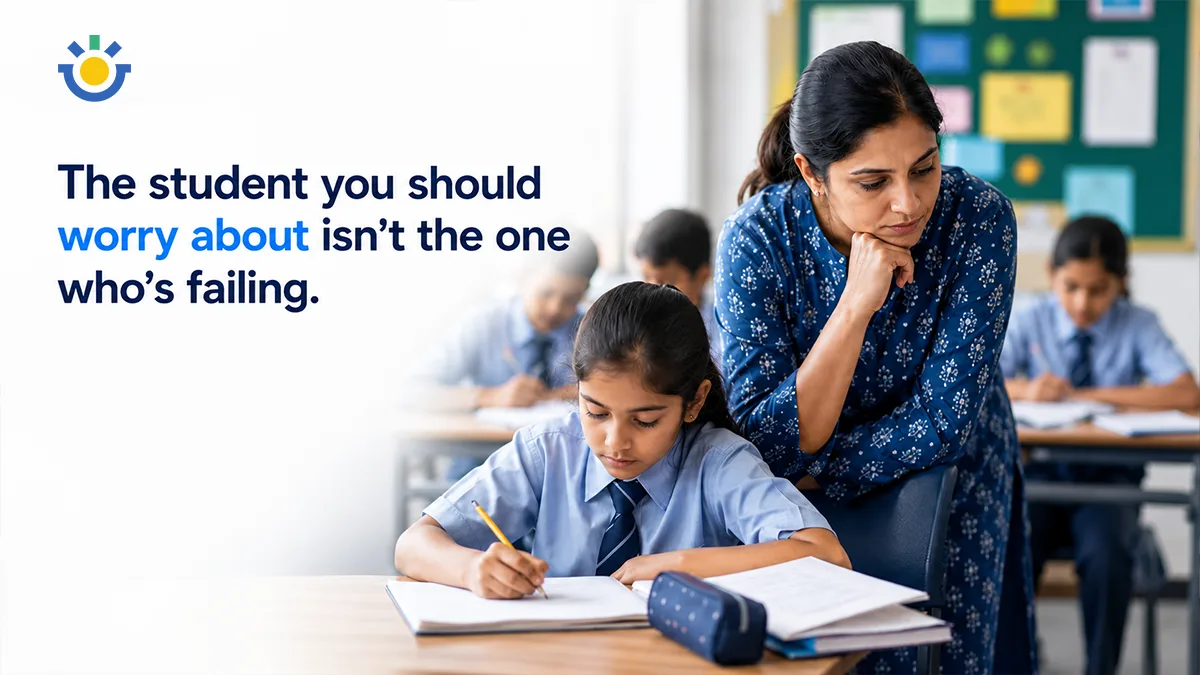
The Student You Do Not See
When we think about the students we need to worry about, our minds usually go straight to the ones who are failing. But the truth is, the failing student is actually the easiest one to spot. Everybody in the school building can see them.
The computer system flags their name in red, their low marks make the problem completely obvious on every test tracker, their parents get a regular call from the office, and the school quickly arranges extra remedial classes after school. A failing student sets off every single alarm in the entire building. That student is not a secret. You can see their struggle clearly.
The student you really need to worry about is someone completely different. It is the Class 8 girl sitting quietly in the third row.
At the start of the year, her marks were a solid 78 percent. By the middle of the term, her score dropped down to a 71 percent. If nothing changes in her life, she will likely get a 64 percent by the next term. By the time she reaches Class 10, everyone will simply say she is "just not really a math person."
But nobody actually decided that about her. There was no big dramatic moment in class. She did not fail a major exam, she did not cause trouble in the room, and there was no worried phone call sent to her home. She simply drifted away, one quiet percentage point at a time. She moved in a downward direction that was too small and too quiet for any single test score to flag.
And here is the part that hurts: you were standing right there in the classroom the entire time it happened.
It Was Never an Effort Problem
When you realize a student has slipped away like this, your first instinct as a good teacher is to feel guilty. You feel like you missed something obvious. You feel like you did not work hard enough.
But you didn't miss anything, and you are not a bad teacher. The truth is simple: you were busy teaching forty other children at the exact same time.
Teaching is, before it is anything else, a massive problem of human attention. Every single day, you bring a truly heroic amount of energy and care into your classroom. But you only have a fixed amount of human attention, and you have forty-plus individual kids competing for that attention during every single period of the day.
Because of this, your attention naturally goes to the loudest signals in the room. You look at the student who is excelling and raising their hand for every question. You look at the student who is completely failing and needs immediate help. You look at the child who will not stop talking at the back of the room, or the child who is clearly crying or upset today.
That is not a flaw in how you teach. That is just what any normal human being does when they have a limited amount of time and an endless amount of things asking for their focus.
The Danger of the Quiet Slide
The real problem is that "quietly drifting" is the one signal in a school that is never loud. A slow slide backwards does not interrupt your lesson. It does not create a scene in the hallway. It does not fail a test completely. It does not cry out for help.
The student just sits there in the third row, getting a sixty-two point five percent, and stays invisible precisely because their drop is not dramatic. By the time a slow drift finally becomes loud enough for a busy teacher to notice, it has usually stopped being a drift. It has become a permanent fact. The student has already lost their confidence and given up on the subject.
As a human being, you can easily watch forty faces in a room. You can see who is smiling, who is tired, and who is looking out the window. But what you cannot do—what no human being can ever do—is hold forty individual trajectories in your head at the exact same time.
You cannot manually track the exact direction each child is moving in over several weeks, across five different school subjects, compared to where they were two months ago. Human brains are simply not built to calculate that much moving data while simultaneously managing forty energetic human beings in a single closed room.
What Modern Tools Are Actually For
This is the exact moment where a good teacher is right to get suspicious. Teachers are tired of hearing about new technology or apps that promise to change education. So let us be completely honest about it.
This is not a pitch for a cold machine that tries to grade your students' essays, judge your personal teaching style, or watch you through a classroom camera. A computer cannot teach your class. It can never read a child the way you can when you crouch down by their wooden desk to see what they are writing.
A computer has absolutely no idea that Aarav’s grandfather passed away last month, or that Simran only opens up and speaks during small group work. Knowing those deeply human details is your job, and it will always be your job because you are the teacher.
What a smart system can do is handle the one thing you are always short on: it can watch the moving trajectories that your eyes cannot see. It can notice quietly, in the background of your busy day, that the quiet girl in the third row has moved downward three small times in a row while everyone else's attention was focused elsewhere. And instead of giving you a massive, confusing chart, it can hand you one simple sentence:
Talk to her on Monday.
That is it. That is the whole goal of good school technology. It is not trying to replace your human judgment. It is trying to point your judgment in the right direction. It takes the quiet problem that naturally slips through the cracks of a forty-student classroom and places it right back in front of the one person who can actually do something to fix it: you.
Reclaiming Your Focus
The best teachers in the world were never the ones who caught every single detail. Nobody can catch everything. The best teachers are simply the ones who catch problems early, while they are still small and easy to mend.
Catching things early is not about working longer hours or staying at school until late at night. It is simply about being told, in time, exactly where you need to look.
✓ Look at the history, not just today. When a student turns in a piece of work, take a quick second to look at their past three scores. Is the line moving up, or is it slowly dipping down?
✓ Check in on the middle rows. It is easy to spend all our time on the front row or the back row. Make a conscious effort to speak to the quiet students in the middle who never cause trouble.
✓ Trust the early warnings. If a system or a small quiz shows a student is starting to drop, do not wait for the final exam to see if they bounce back. A five-minute chat next Monday can save their entire term.
The Ocoviz Method: We created Ocoviz to be the extra pair of eyes that every teacher needs in a crowded room. It surfaces the quiet drift before it turns into a failing grade. By watching the trends in the background, it ensures your valuable attention lands exactly where it matters most, while you still have time to make a difference.
Conclusion
Your value as a teacher is not found in sorting through data sheets or trying to guess which student is quietly falling behind. Your value is found in the moments when you connect with a child and help them understand a difficult idea. By letting smart systems track the trajectories, you can free up your mind to do what you do best: look into those forty faces and give them the human care they need.
Frequently Asked Questions
Why do quiet students often slip through the cracks in large classrooms?
How can a teacher tell the difference between a bad day and a dangerous downward trend?
Does tracking student trajectories mean more administrative work for teachers?
How do you approach a student who is quietly drifting without hurting their confidence?
Know Exactly Where to Look This Monday
Ocoviz tracks the hidden student patterns for you, leaving you free to focus on the human side of teaching.
🚀 Book a Free Demo