Why Good Parents Still Get Blindsided at the PTM
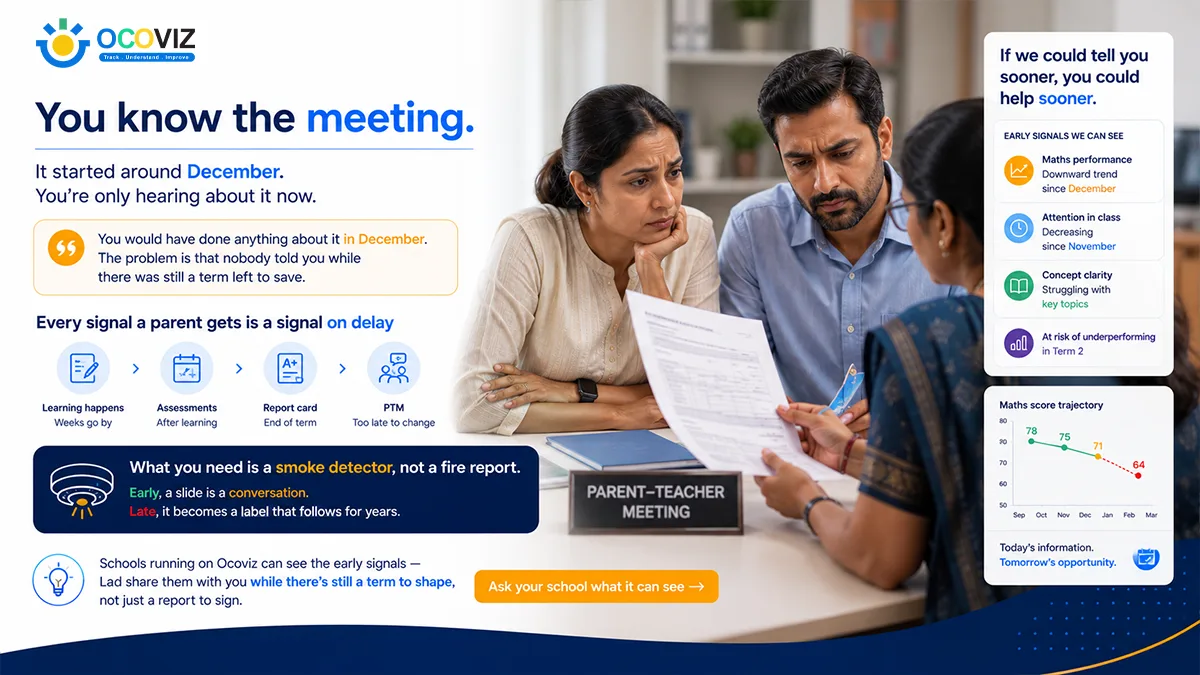
You know the meeting.
It's the parent-teacher meeting in June, and the teacher is kind and means well, and somewhere in the conversation you realise that something has been going wrong since around December. The teacher isn't hiding anything. The report card in your hands isn't wrong. But you're sitting there doing the math, and the math is: this started six months ago, and I'm only hearing about it now.
You would have done anything about it in December. You still would. The problem was never willingness. The problem is that nobody told you while there was still a term left to save.
Every signal a parent gets is a signal on delay
Think about how information actually reaches you as a parent. Marks come after the exam. The exam comes after months of learning. The report card comes at the end of the term. Every meaningful signal about your child's learning is, by design, a summary of something that is already finished.
So you find out your child struggled with a chapter — after the chapter is done and the class has moved three units ahead. You find out attention was slipping — after a full term of it slipping. You find out at the PTM — when the PTM is essentially a debrief on a term you can no longer change.
This isn't anyone being negligent. It's just how the machinery of a school reports information: in arrears. And it puts loving, attentive, completely capable parents in an impossible position. You're ready to help. You just keep being handed the alarm after the fire is out.
A smoke detector, not a fire report
Here's the distinction that matters. A report card is a fire report. It's an accurate, official account of what already burned. What a parent actually needs is a smoke detector — something that goes off while there's still time to walk into the room.
Imagine finding out in week three that your daughter has quietly disengaged from a subject, instead of finding out in month five that her marks dropped. Imagine a small, early nudge — she's been drifting in maths, this is a good week to sit with her — instead of a heavy, late verdict you can only absorb, not act on. The information is the same information. The only thing that's changed is the timing. And in your child's education, timing is nearly everything.
Early, a slide is a conversation. Late, it's a "she's just not a science person" — a label that will quietly follow her for years, decided by nobody, agreed to by everyone, simply because no one saw it soon enough to argue with it.
The point isn't to worry more. It's to know sooner.
Let's be clear about what this is not. It's not a reason to panic, or to hover, or to treat every dip as a crisis — children dip, recover, and grow, and most drifts are small and fixable exactly because they're caught small. The point isn't to make you more anxious. It's the opposite. It's to replace the specific dread every parent carries — what if something's wrong and I'm the last to know? — with something calmer: the confidence that if something starts to slip, you'll hear about it while it's still small enough to fix together.
You will always be the one who helps your child. All a school can do is make sure it tells you in time to be that person.
Schools running on Ocoviz can see the early signals — and share them with you while there's still a term to shape, not just a report to sign. Ask your school what it can see →
See how early Ocoviz would flag your at-risk students
Book a 20-minute demo and we'll show you the Risk Radar on a school like yours.
🚀 Book a Free Demo