You Can Watch 40 Faces. You Can't Watch 40 Trajectories.
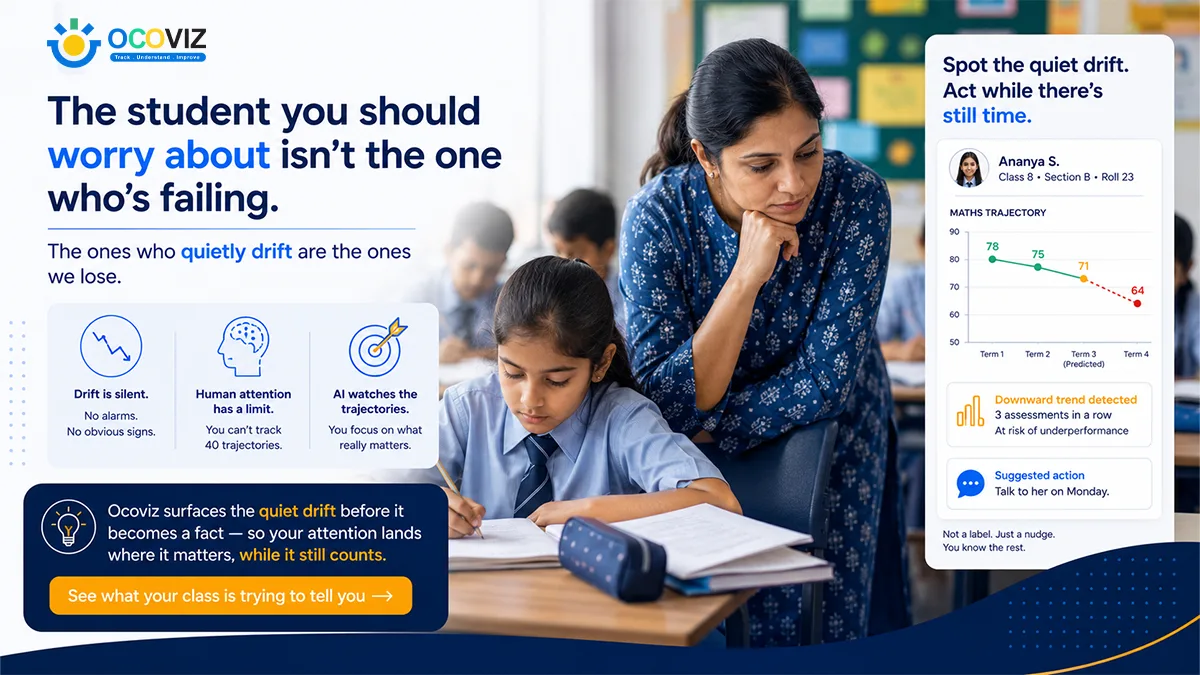
The student you should worry about isn't the one who's failing.
The failing student is easy. Everyone sees them. The system flags them, the marks make it obvious, the parents get a call, remedial classes get arranged. A failing student sets off every alarm in the building. That's not a blind spot. That's the opposite of a blind spot.
The one to worry about is the Class 8 girl in the third row who used to be a 78, is now a 71, and — if nothing changes — will be a 64 by the next term and "just not really a maths person" by Class 10. Nobody decided that about her. There was no dramatic moment, no failed test, no phone call home. She simply drifted, one quiet percentage point at a time, in a direction no single data point was ever loud enough to flag.
And here's the part that stings: you were in the room the whole time.
It was never an effort problem
The instinct is to feel like you missed something. You didn't. You were teaching forty other children.
Teaching is, before it is anything else, an attention problem. You have a fixed and frankly heroic amount of attention, and you have forty-plus kids competing for it every single period. So your attention goes, correctly, to the loudest signals — the child who's excelling, the child who's failing, the one who won't stop talking, the one who's clearly upset today. That's not a flaw in how you teach. That's what any human being does with finite attention and infinite demand.
The problem is that "quietly drifting" is the one signal that is never loud. A slow slide doesn't interrupt the class. It doesn't fail a test. It doesn't cry. It just sits in the third row, sixty-two point five percent, and waits — invisible precisely because it's undramatic. By the time a slow drift becomes loud enough to notice, it has usually stopped being a drift and become a fact.
You can watch forty faces. What you cannot do — what no one can do — is hold forty trajectories in your head at the same time. The direction each child is moving in, over weeks, across subjects, compared to where they were. That's not a thing human attention is built to track. It's a thing that gets lost in the sheer noise of forty individual human beings in a room.
What AI is actually for (and what it isn't)
Here's where a teacher is right to get suspicious, so let's be blunt about it. This is not a pitch for a machine that grades your students, judges your teaching, or watches you through the CCTV. It won't teach the class. It can't read a child the way you can when you crouch by their desk. It has no idea that Aarav's grandfather passed away last month, or that Simran only opens up in group work. That's your job, and it will always be your job.
What a good system can do is exactly the one thing you're short on: it can watch the trajectories you can't. It can notice, quietly, in the background, that the girl in the third row has moved the wrong way three assessments in a row while everyone's attention was elsewhere. And it can hand you one sentence:
Talk to her on Monday.
That's it. That's the whole ambition. Not to replace your judgement — to point it. To take the thing that slips through the cracks of a forty-student room and put it back in front of the one person who can actually do something about it: you.
The best teachers were never the ones who caught everything. Nobody catches everything. The best teachers are the ones who catch it early. That's not about working harder. It's about being told, in time, where to look.
Ocoviz surfaces the quiet drift before it becomes a fact — so your attention lands where it matters, while it still counts. See what your class is trying to tell you →
See how early Ocoviz would flag your at-risk students
Book a 20-minute demo and we'll show you the Risk Radar on a school like yours.
🚀 Book a Free Demo