How to Predict Student Dropout and Learning Gaps 4 Weeks Before the Exam using Learning Intelligence
Imagine sitting in your office two weeks after the final board exams. The report cards are finalized, and the data is bleak. A promising student has failed mathematics entirely, and two families have just walked into the admin block to request Transfer Certificates (TCs), citing that their children felt entirely unsupported during the term.
As a principal, you interview the teachers. The math teacher points out that the student missed critical foundational lectures. The class coordinator mentions that the student had become increasingly withdrawn over the last six weeks. The front office notes that the parents had been lagging behind on fee communications.
The pieces of the puzzle were all there. But they were scattered across three different desks, hidden in three isolated software modules.
This is the tragedy of modern school administration: we only discover a student is in crisis after the crisis has officially broken. By the time a report card reflects a failing grade or a parent requests a TC, the opportunity to intervene has passed. Schools don’t lack data; they lack the infrastructure to connect the early warning whispers before they turn into academic failure.
The Direct Answer
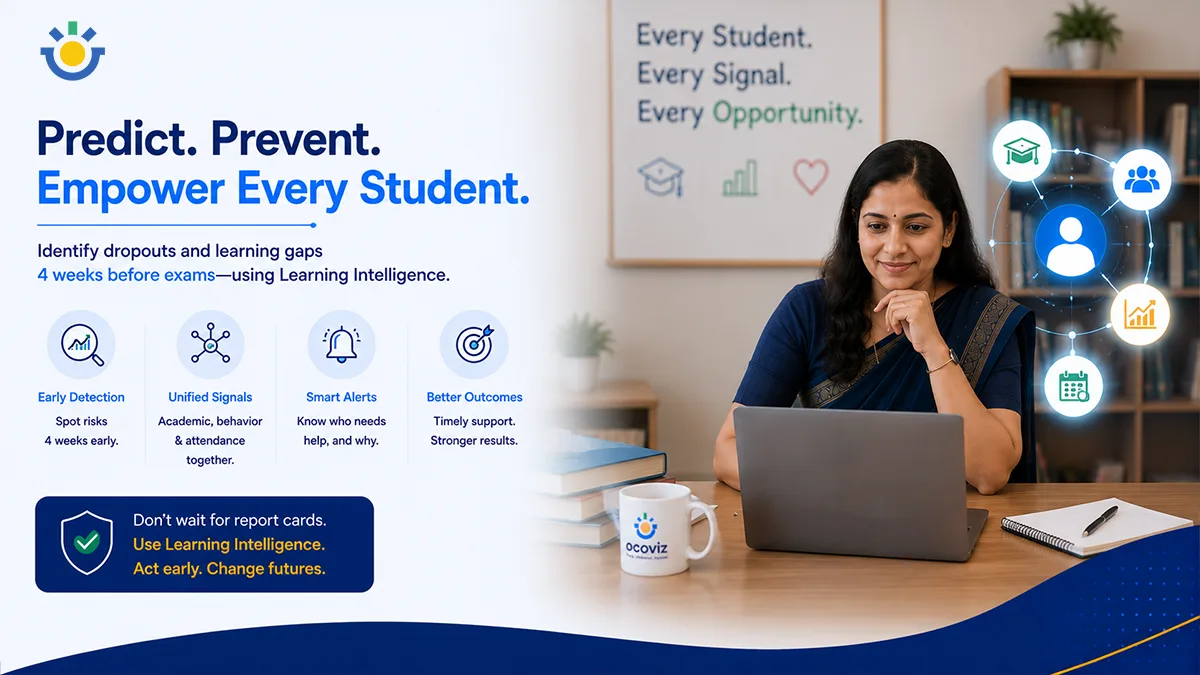
Schools can accurately predict academic failures and structural dropouts four weeks before exams by utilizing Unified Signal Intelligence (USI). By continuously cross-referencing shifting patterns in class attendance, behavioral participation, and micro-assessment trends into a centralized system, educators receive automated alerts to patch learning gaps before they reflect on a final transcript.
What Exactly is "Unified Signal Intelligence" in a School Context?
In a school, a "signal" is any measurable data point generated by a student. A drop in attendance is a signal. A missed homework assignment is a signal. A sudden drop in library book checkouts or a silent profile during class discussions are all signals.
In traditional school setups, these signals remain isolated. The attendance system doesn't know about the gradebook, and the gradebook doesn't know about student wellness logs.
Unified Signal Intelligence (USI) is the practice of pulling these distinct streams into a single analytical engine. Instead of analyzing an isolated data point, USI looks at the intersections. When behavioral changes align perfectly with a slight dip in weekly assessment scores, the system identifies a compound risk trajectory that human eyes might completely miss during a busy week.
Why Do Traditional Early Warning Signs Fail Us?
Most schools rely on a single, high-stakes metric to find struggling students: the mid-term exam. But relying entirely on mid-terms is highly reactive for two distinct reasons:
- It's Too Late: By the time a mid-term is graded, recorded, and reviewed, weeks have passed. The curriculum has already marched forward to complex topics.
- It Misses Hidden Dropouts: A student might score a safe 75% on a mid-term, masking the fact that they completely failed to comprehend the foundational calculus concept taught the following week.
Reactive School Monitoring = Evaluates risk post-examination, Looks at academic grades alone, Relies on manual teacher flagging, High mid-term student attrition.
Proactive Signal Intelligence = Identifies risk 4 weeks pre-exam, Merges attendance, behavior, & marks, Automatically alerts coordinators, Timely, successful remediation
True insight requires looking at micro-trends. This is where a modern system like Ocoviz changes the game. By constantly tracking daily classroom submissions, continuous assessments, and participation data in the background, it builds a real-time risk index for every student without asking teachers to fill out specialized diagnostic paperwork.
How Do We Spot a Learning Gap 4 Weeks Out?
Catching a concept gap four weeks before an exam requires moving away from cumulative scores and moving toward topic-level tracking.
When weekly micro-quizzes are mapped to specific skills (such as "quadratic equations" or "organic chemistry bonds"), the system tracks comprehension at a granular level. If a student's daily homework scores in a specific sub-topic drop below a benchmark for three consecutive assignments, the dashboard flags a specific learning gap alert. This gives your remedial cell an exact four-week window to run target sessions before the cumulative exam paper lands on the student's desk.
What Are the Non-Academic Triggers for School Dropout?
Academic failure rarely happens in a vacuum; it is often the final stage of institutional disengagement. To predict actual school dropouts—students leaving for competing schools—your intelligence layer must actively track behavioral and administrative touchpoints.
A sudden 15% drop in parent portal logins, consecutive unexcused absences on Mondays, and unresolved fee absolute delays are strong non-academic signals. When an operating system unifies these administrative variables with academic trends, it spots the risk profile of a disengaged family long before they walk into the administration block to withdraw enrollment.
Practical Takeaways
- Connect attendance to your gradebook: Set an automatic alert for any student whose weekly subject attendance drops below 80%, immediately notifying the subject teacher.
- Implement weekly 5-minute formative checks: Use brief digital exit tickets at the end of every week to log basic concept comprehension rather than waiting for monthly tests.
- Establish a cross-departmental risk review: Have your academic coordinators and student counselors review a unified risk dashboard on the 1st of every month.
- Build an early remediation framework: Formally schedule your revision and bridge classes exactly four weeks prior to major terms, directed specifically by data-logged learning gaps.
Conclusion
True educational leadership isn't measured by how well we document student failure; it is measured by how effectively we prevent it. By shifting from clunky, retrospective databases to a living system fueled by Unified Signal Intelligence, you give your faculty the ultimate gift: time to act. Spotting a gap four weeks before an exam transforms a potential failure into a story of recovery, ensuring your school remains a place where no student slips through the cracks.
Frequently Asked Questions
Does implementing predictive intelligence add extra reporting work for our teachers?
Can the system distinguish between a temporary dip in grades and a genuine dropout risk?
How far back does the data need to go to provide accurate pre-exam predictions?
How can we share these predictive insights with parents without causing panic?
Will our school need to hire data analysts or IT experts to read these predictive dashboards?
How does predicting learning gaps early affect our school’s overall board exam averages?
Can this predictive intelligence help us identify and support exceptionally high-performing students?
What happens to our predictive data model when the academic year ends?
How does predictive data help lower student attrition and protect the school fee revenue?
Spot the Gaps Before They Turn Into Failure
See how Ocoviz transforms scattered classroom signals into actionable early warning dashboards that protect student success.
Schedule a Predictive Analytics Demo