Why Giving Students a Choice in Assessments Changes Everything
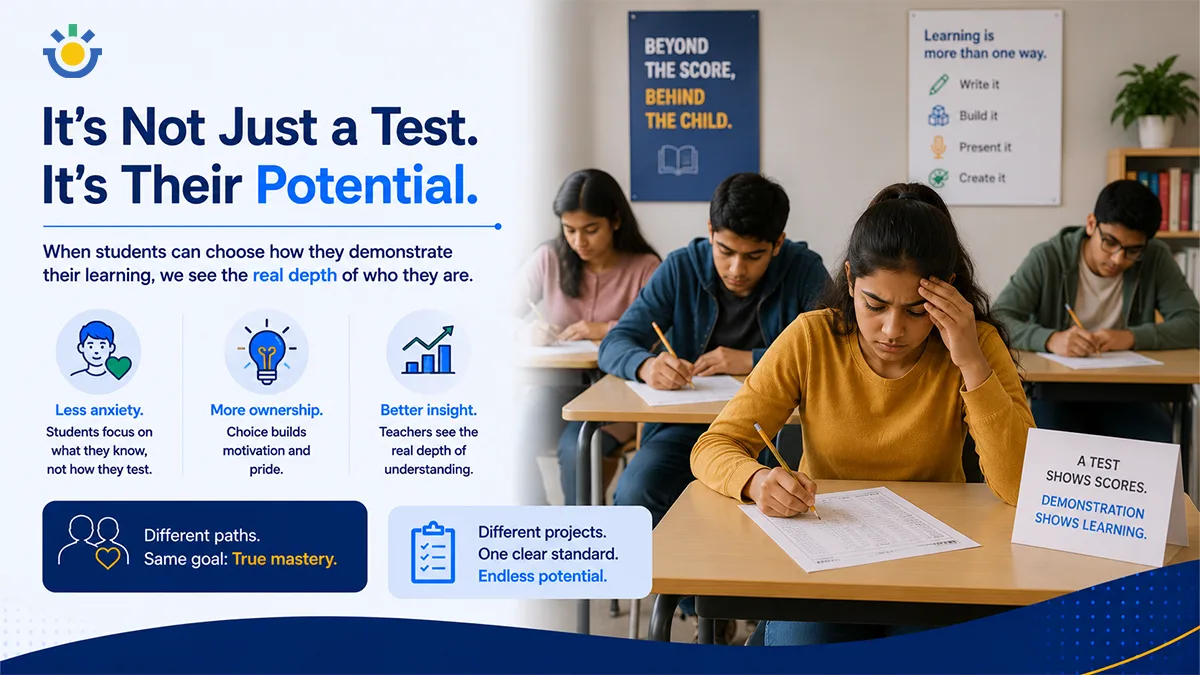
Imagine a quiet classroom during a mid-term exam. Row after row of students bend over identical sheets of paper, filling in little circles with graphite pencils. For some, the test is a smooth breeze. For others—students who understand the concepts completely but freeze under standard test conditions—it is an exercise in pure anxiety.
At the end of the day, the teacher collects a stack of identical papers. The grades will tell the school who is good at taking tests, but they rarely show the true depth of what each unique child actually understands.
When assessments are treated purely as a tool to rank students with a single number, the joy of learning evaporates. Students begin to ask, "Is this going to be on the test?" instead of asking, "How does this work?"
But it doesn't have to be this way. When you shift the focus from testing to demonstrating, the entire energy of the classroom changes.
The Direct Answer
Giving students a choice in how they demonstrate their learning means providing multiple pathways—such as presentations, building projects, or writing reports—to prove they master a specific concept. This approach increases student ownership, reduces academic anxiety, and gives teachers a more accurate picture of a child's true capabilities.
The Deep Dive
Why Do Traditional Tests Miss the Mark?
Standard exams operate on a flawed assumption: that every human brain retrieves and processes information in the exact same way. A brilliant writer might struggle to express their thoughts within the rigid constraints of a 20-question multiple-choice grid. A talented speaker might fail to show their deep understanding of history on a timed essay, yet they could explain the exact same historical events flawlessly in a speech.
When we rely solely on uniform testing, we create artificial barriers to achievement. Students who struggle with test anxiety start to view themselves as unintelligent, while advanced students learn to do the bare minimum required to secure an A grade. Neither group is truly engaging with the material.
Shifting from "Testing" to "Demonstrating"
Introducing choice into your classroom doesn't mean lowering your standards or abandoning your rubric. The learning objectives remain exactly the same for every single child; only the output method changes.
For example, if the core academic goal is to prove that a student understands the causes of the American Revolution, the output could look completely different depending on the student's strengths:
- The writer can submit a traditional analytical essay.
- The artist can design a detailed, annotated comic strip illustrating the timeline.
- The orator can record a podcast episode analyzing the historical figures involved.
Because each student is working within their zone of confidence, they spend less energy fighting the format and more energy mastering the actual content.
The Myth of the Impossible Grading Burden
The most common concern teachers have when introducing choice is simple: "How am I supposed to grade thirty completely different projects without losing my weekends?"
The secret lies in objective-based rubrics. Instead of grading the medium (the video quality or the handwriting), you grade the mastery of the concept. Your rubric doesn't care if it is a poster or a podcast; it looks for specific criteria, such as accurate historical data, clear arguments, and logical organization.
When classroom tools are flexible, keeping track of these varied milestones becomes effortless. Ocoviz helps educators track student progress by focusing on skill mastery rather than just numerical averages. Instead of trying to force diverse projects into a rigid old-school spreadsheet, teachers can easily document a student's unique learning journey and share those milestones directly with families.
Practical Takeaways
- ✓ Start with limited options: Do not give absolute freedom immediately. Offer a simple menu of three specific choices (e.g., a written report, a visual poster, or a short video).
- ✓ Keep the rubric identical: Grade the core learning objectives, not the format of the project. A single, clear rubric should apply to all choices.
- ✓ Allow students to pitch ideas: Give advanced students the space to suggest their own unique way to prove their mastery, encouraging deep self-direction.
- ✓ Focus on the process, not just the product: Check in on student progress during class time to ensure they are on the right track before the final submission date.
Conclusion
Assessments should be a celebration of what a student has discovered, not a trap designed to catch what they forgot during a stressful hour. By opening the door to choice, you turn your classroom into a vibrant space where creativity thrives and learning becomes permanent. When students are given ownership over how they show their knowledge, they don't just achieve better grades—they build the confidence to become lifelong learners.
Frequently Asked Questions
Does offering choices mean I am making the curriculum easier for my students?
How do I prepare students for mandatory standardized testing if I use choice assessments?
What should I do if a student gets overwhelmed by having choices?
How do I explain this style of grading to parents who expect traditional test marks?
Bring Meaningful Learning into Focus
Discover how Ocoviz replaces rigid, old-school gradebooks with a modern dashboard that tracks true skill mastery and keeps families connected.
✓ Explore the Ocoviz Progress Tracker