Why Hanging a Smart TV on the Wall Doesn't Make a School "Future-Ready"
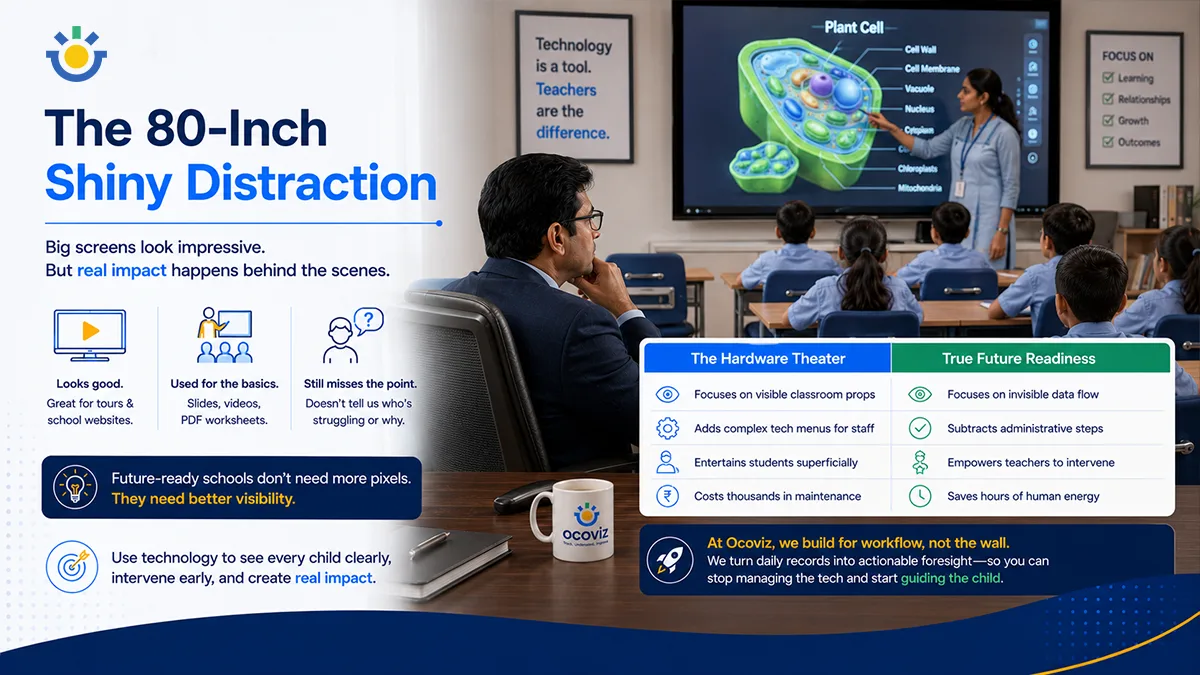
The 80-Inch Shiny Distraction
If you want to sell a school to a prospective parent in the modern era, the recipe is remarkably simple. You do not show them your remedial reading scores, and you do not talk about your teacher retention rates. Instead, you take them on a physical tour of a classroom featuring a massive, 80-inch interactive smart TV glowing brightly at the front of the room.
The parent looks at the screen, sees a colorful digital diagram of a plant cell or a solar system, and instantly thinks: Wow, this school is living in the future. My investment is completely worth it.
This is the great illusion of modern educational technology. We have confused the purchase of shiny hardware with the delivery of deep learning. School boards and directors allocate huge portions of their annual budgets to buying smart boards, tablets, and high-definition displays because hardware is highly visible. It can be photographed for the school website. It looks impressive during open-house events. It gives the leadership team a comforting feeling that they are keeping up with the times.
But if you pull up a chair, sit in the back of that classroom for an entire week, and watch what happens when the tour groups leave, the illusion quickly falls apart.
You will see that the expensive smart TV is being used for exactly three things: displaying basic text slides that used to be written on a cheap green chalkboard, playing YouTube videos to keep the children quiet, and showing PDF worksheets. The technology has changed, but the pedagogy remains completely stuck in the past. We haven't revolutionized learning; we have just bought very expensive wallpaper.
The Tragedy of Hardware Theater
When a school relies on "hardware theater," it creates a massive hidden tax on the entire ecosystem. First, there is the financial drain. Money spent on maintaining luxury screens is money that cannot be spent on hiring better assistant teachers, buying high-quality physical books, or upgrading the school library.
Second, there is the cognitive drain on the teachers. Educators are suddenly forced to attend mandatory weekend workshops to learn how to operate complex interactive software menus, configure wireless casting settings, and troubleshoot HDMI connection bugs.
Instead of walking into class focused entirely on the emotional and intellectual state of their students, the teacher walks into class feeling anxious about whether the screen will connect to the local internet network. If the software crashes mid-lesson, ten minutes of valuable teaching time are instantly vaporized while the teacher scrambles to find the IT coordinator.
More importantly, these screens do not solve the fundamental problem of the modern classroom: the invisible student. A child sitting in the third row can stare directly at a gorgeous, animated 3D animation on a smart TV while their mind is completely blank. The screen does not tell the teacher that the child missed the foundational concept taught two Tuesdays ago. The screen does not highlight who is falling behind. It simply projects information outward, acting as a one-way megaphone rather than a two-way bridge.
Moving Past the Pixels
True innovation in a school system does not happen on a wall. It happens in the invisible lines of communication that connect the teacher, the student, and the family. A school becomes truly "future-ready" when its tools clear away administrative friction so that adults can see the children clearly.
Imagine a school that stops buying more screens and instead focuses on refining its data flow. Instead of a teacher spending their energy building flashy presentation slides, they use a quiet, background tool that tracks daily curriculum coverage and student trends in real-time with a single tap.
If a student misses a step, the system flags it instantly—not with a loud, flashing red alarm, but with a simple note on the dashboard. The teacher sees it, walks over to the child's desk, and provides a human intervention. That is what a future-ready school looks like. It uses technology to create more human contact, not less.
Practical Takeaways for School Directors
If you want to ensure your school's technology investments actually drive learning outcomes rather than just looking good on brochures, consider these steps:
✓ Enforce a "Purpose Audit" on hardware. Before purchasing a new set of screens, ask your department heads: What can this tool do that a standard whiteboard and a $200 projector cannot? If the answer is just "it's interactive," save the money.
✓ Prioritize data mobility over visual display. Invest in tools that make student insights mobile. A teacher with a simple tablet that instantly shows every child’s learning trajectory is ten times more effective than a teacher standing in front of a $5,000 smart wall.
✓ Focus on the loops, not the look. Look at how long it takes for a classroom struggle to be noticed, logged, and communicated to a parent. If that loop takes two weeks of paperwork, your smart TVs aren't saving you. Reduce that loop to twenty-four hours using clean software.
The Ocoviz Way: At Ocoviz, we don't build software for the wall; we build it for the workflow. We know that a school doesn't change because you added more pixels to the classroom. It changes because you gave the principal and the teacher a clear, uncluttered view of student progress. Ocoviz works quietly behind the scenes, turning daily records into actionable foresight so you can stop managing the tech and start guiding the child.
Frequently Asked Questions
Are smart TVs inherently bad for classrooms?
How should a school measure the ROI of technology?
What should schools buy instead of expensive hardware?
Trade the Tech Theater for Real Insights
Discover how Ocoviz bypasses the flashy distractions of traditional EdTech to give your leadership team the clean, actionable student data they actually need.
✓ Explore the Ocoviz Dashboard