The Report Card Shock: Why Your School Software Is Hiding the Truth from Parents
The Silent Drip Before the Flood
Every academic year, a predictable script plays out in principal offices around the world. A parent walks in, slams a report card onto the desk, and demands an explanation. Their child has received a failing grade in mathematics or science, and the parent is furious.
The defense from the school is usually administrative: "But we put the quiz marks into the portal every fortnight."
To which the parent gives the ultimate, undeniable counter-argument: "I am a busy working parent. I don’t have the time to hunt through three layers of online menus every Tuesday just to check if my child understood fractions. Why didn't anyone just tell me?"
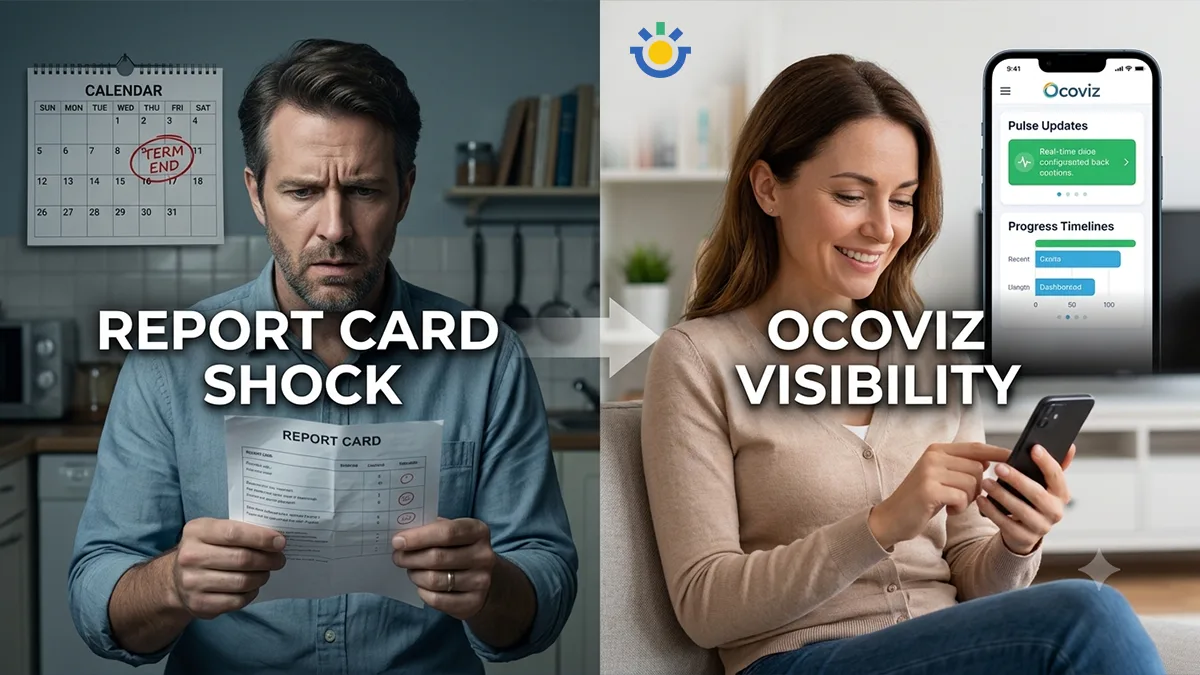
This is the "Report Card Shock." It is the sudden, painful realization that a child has spent the last ninety days quietly drifting backward in the classroom while the adults around them assumed everything was being handled.
When a parent experiences this shock, a structural crack forms in their relationship with the school. They stop viewing the institution as a supportive partner in raising their child and start viewing it as a cold, bureaucratic black box that collects tuition fees but hides the truth.
The Problem with Data Vaults
The root of this crisis isn't a lack of teacher care; it is the fundamental design of traditional school software and portal systems.
Legacy school systems were never built to communicate with families. They were built for school accountants, auditors, and administrators. They function as digital storage vaults. When a teacher inputs a low quiz score or logs a missed assignment into a standard portal, that data point simply sits in a closed database, waiting for someone to manually generate a report at the end of the month or the end of the term.
This flaw creates three major human problems in your school community:
- It requires parent hyper-vigilance. For a traditional portal to work, parents must act like data auditors. They have to log in constantly, navigate confusing tables, and interpret raw percentages themselves. Busy parents simply cannot do this.
- It turns teachers into data clerks. Because inputting marks into an old system involves a dozen clicks per student, teachers wait until the absolute weekend before deadlines to upload everything in a massive, exhausting batch. By the time the data is in the system, the learning gap is already weeks old.
- It delays the intervention. If a child fails a quiz in week two, that is a minor issue that can be fixed with twenty minutes of focused review. If that failure isn't addressed until week twelve, it has grown into a massive learning deficit that requires expensive private tutoring.
Shifting from Storage to Streams
To eliminate the report card shock, school leadership must change how they think about data. Data should not be stored until it becomes a crisis; it should flow in tiny, manageable streams while it is still actionable.
Imagine a school where the software does the heavy lifting. When a teacher logs a daily classroom update, the system doesn't wait for the end of the month. If the system notices a pattern—such as two consecutive missed homework tasks or a sudden drop in a core concept—it automatically sends a quiet, friendly update directly to the parent’s mobile dashboard.
The notice doesn't read like a formal disciplinary warning. It simply says: "Sam struggled a bit with long division today. Here is the core concept we are practicing this week if you'd like to review it together at home."
Suddenly, the entire dynamic changes. The parent isn't blindsided in December; they are empowered in October. They feel included, informed, and capable of helping their child before a small stumble turns into a failing grade.
Strategic Steps to End the Blindside
If you want to protect your school from the friction of report card shock, implement these operational shifts:
- Automate the alerts, don't burden the staff. Do not ask teachers to send individual emails every time a student struggles. Choose an administrative infrastructure that automatically catches trends from the daily marks sheet and passes those insights to parents seamlessly.
- Focus on progress, not just percentiles. A raw score of 60% doesn't tell a parent much. Show them the trajectory. Is the child moving up from a 50%, or slipping down from an 80%? The direction of travel matters far more than the isolated number.
- Bridge the home-school gap early. Make sure your communication system allows parents to easily respond to a struggle update with a single tap, letting the teacher know: "We reviewed this at home tonight, please check on them tomorrow."
The Ocoviz Way: Ocoviz was built explicitly to destroy the data blindspot that ruins parent-school relationships. Instead of acting like a heavy, passive storage vault, Ocoviz works as a live communication stream. When teachers enter daily progress with our single-tap interface, Ocoviz automatically translates those clicks into clear, calm, and actionable timelines for parents. We ensure that milestones are celebrated instantly and struggles are caught early—so that report card day becomes a moment of shared pride, never a shock.
Conclusion
End-of-term surprises are completely preventable, yet traditional school portals allow them to happen every single month. When schools rely on heavy databases that require parents to hunt for information, they create an environment of anxiety and mistrust. By switching to a live, automated stream that catches small learning gaps early, traditional schools can turn report card day from a stressful confrontation into a celebration of teamwork. Protecting your school’s enrollment means ensuring that parents are never the last to know how their child is doing.
Frequently Asked Questions
If parents see every small mistake, won't they get worried over nothing?
Does this mean teachers have to spend all night texting parents?
What if a parent starts arguing about a bad grade right away?
How does the app know if a student is really stuck or just having one bad day?
If parents see a low score right away, won't they just get mad at the teacher?
Why can't schools just use their old portals to show grades?
How does catching mistakes early keep families from leaving the school?
Eliminate the End-of-Term Panic
Discover how Ocoviz turns cold academic data into real-time, comforting insights that keep parents informed and students on track.
✓ Explore the Ocoviz Live Stream Dashboard