Data Fatigue: How to Stop Collecting Records and Start Using Them
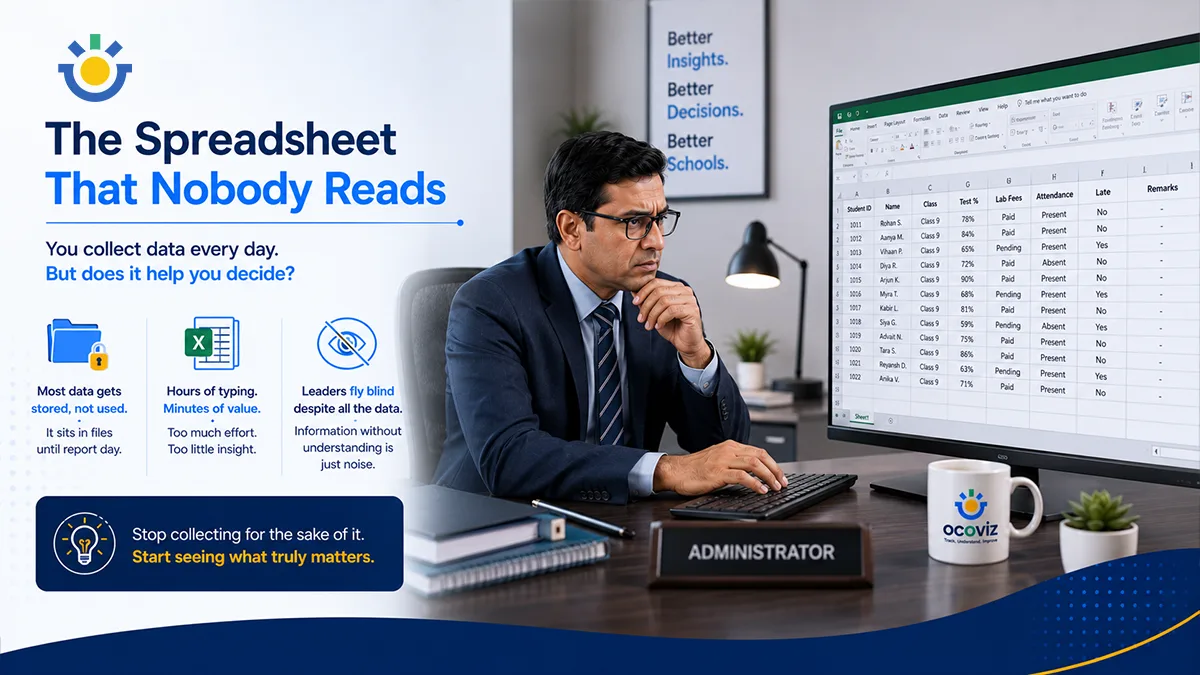
The Spreadsheet That Nobody Reads
It is late on a Friday afternoon, and a school administrator is sitting in front of a giant computer screen. They are typing rows of numbers into a massive spreadsheet. They enter the latest test percentages for Class 9, check off who paid their lab fees, and log which students were late to the morning assembly.
This process takes hours. It requires careful clicking, constant typing, and deep concentration.
Finally, the administrator hits the "Save" button, closes the window, and walks out of the office. They feel a sense of relief because the data has been safely collected.
But if we are being completely honest, what actually happens to that file next week? In most schools, absolutely nothing happens to it. It simply sits in a digital folder on a server, undisturbed, until the end of the year when someone needs to print out a summary report.
This is the reality of modern school management. Schools today are absolute goldmines of information. Every single day, your teachers and staff generate thousands of data points.
You record when a child goes to the nurse, when they miss a homework assignment, and when they get a gold star. Yet, despite collecting all this information, most school leaders still feel like they are flying blind. This is the classic trap of data fatigue: we are spending all our energy collecting records, leaving us with zero time to actually use them.
The Difference Between Storage and Sight
Many schools buy expensive software platforms because they want to become "data-driven." They are promised that if they track everything on a computer screen, their school will automatically improve. But there is a huge difference between storing information and actually understanding it. Storing data is easy; any basic digital filing cabinet can do it. Understanding data is where the real value lies.
Think about a standard school database. It can tell you that a student named Rohan got a 60% on his math quiz yesterday. That is a piece of storage. It tells you a cold fact about the past.
But what that database cannot tell you is that Rohan used to get an 85% every week, that his scores have dropped for three weeks in a row, and that his drop always happens during the weeks he misses his first-period class. That is an insight.
When your software only stores records, it forces the human principal or teacher to do all the heavy lifting. You have to open three different windows, compare the files manually, and try to guess what the numbers mean. Because school staff are already incredibly busy, nobody has the time to do that detective work. The result? The data becomes completely useless noise.
The Hidden Workload for Teachers
Data fatigue does not just hurt school leaders; it deeply exhausts your teaching staff. Teachers entered this profession to teach, not to be data entry clerks.
When a school introduces a heavy, complicated administration system, teachers are often forced to spend their valuable planning periods typing detailed notes into digital boxes. They have to log every single small daily quiz, fill out behavioral forms with dropdown menus, and copy numbers from their personal paper notebooks into a clunky school website.
When teachers see that the information they type into the computer just vanishes into a black hole—and never actually helps them teach better on Monday morning—they start to resent the technology. They do it because they have to, but they do it quickly and without much care.
The data goes from being a helpful tool to a painful chore. This creates a dangerous cycle: bad data goes into the system, so bad information comes out of it, and the school continues to make decisions based entirely on guesswork.
Practical Takeaways to Turn Records into Action
Breaking free from data fatigue requires a complete shift in how you think about school technology. You need to stop asking, "How much information can we collect?" and start asking, "How quickly can this information help a human being make a good decision?" Here is how you can start simplifying your school data this week:
✓ Follow the "One-Click" test for staff. Before you ask your teachers to track a new piece of information, ensure it takes less than three seconds to input. If a teacher has to click through five different menus just to log a missed homework assignment, the system is too complicated and will eventually fail.
✓ Look for trends instead of isolated scores. A single low grade or a single absent day does not tell a story. Stop focusing on daily data points and start looking at the trajectory over three to four weeks. A slow, steady change in direction is the only pattern that truly matters.
✓ Automate the summaries completely. Your administrators should never spend their weekends creating charts or typing summaries for the weekly leadership meeting. If your school software cannot generate a clear, easy-to-read overview report automatically in one click, it is time to look for a better tool.
✓ Connect different data types together. True insights happen when you connect separate pieces of information. Look at how attendance connects to grades, or how behavior notes connect to test performance. When you look at the whole child, the numbers finally begin to make sense.
The Ocoviz Way: We built Ocoviz specifically to solve the crisis of data fatigue. Ocoviz does not just sit there like a cold digital filing cabinet waiting for you to search through it. Instead, it works quietly in the background, connecting your attendance, grades, and communication into one simple view. It reads the patterns for you and automatically brings the most important insights straight to your dashboard—giving you the answers you need before you even think to ask.
Conclusion
Data should never be a burden that slows your school down. It should be a wind that pushes you forward. Your school does not need more spreadsheets, more colorful charts, or more rows of numbers. You simply need a clear window that shows you exactly which student needs a helping hand today and which teacher needs your support. By turning your cold records into live, actionable foresight, you can finally beat data fatigue and get back to the human work of running a great school.
Frequently Asked Questions
What is data fatigue in schools?
How can school leaders tell if their software is causing data fatigue?
What is the most important feature to look for in school software?
Does using data take away from the human side of running a school?
Stop Collecting Data. Start Leading with Foresight.
Discover how Ocoviz turns your school’s daily busywork into simple, clear insights that you can actually use to help your students this week.
✓ See Ocoviz in Action