Why Good Parents Still Get Blindsided at the PTM
The Shock of the School Meeting
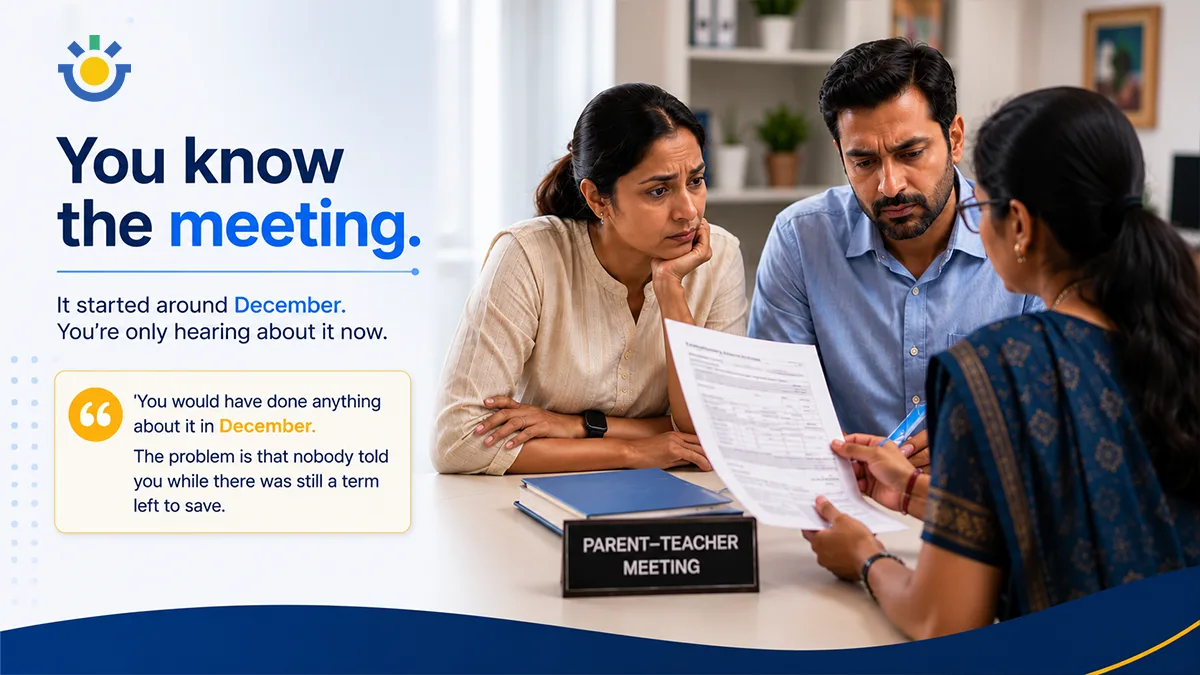
You know the meeting we are talking about.
It is the big parent-teacher meeting at the end of the school term. You sit down in those small classroom chairs, and the teacher is kind, warm, and truly means well. But somewhere in the middle of the conversation, you suddenly realize that something has been going deeply wrong with your child's schoolwork since way back in December.
The teacher is not trying to hide anything from you. The printed report card in your hands is completely correct. But as you sit there looking at the grades, you start doing the math in your head. The math is simple and painful: this problem started six months ago, and you are only hearing about it right now.
As a parent, you would have done anything to help your child back in December. You would have sat down with them every night, found a tutor, or spoken with the teacher immediately. You still would do anything today. The problem was never your willingness to help. The problem is that nobody told you there was a struggle while there was still a full school term left to save.
Every Signal a Parent Gets Arrives on a Delay
Think about how information actually travels from the school to your home. Marks and test scores only come after the exam is already over. The exam itself only happens after months of daily classroom learning. The final report card only comes at the exact end of the term.
By design, every meaningful update you get about your child’s education is a summary of something that is already finished. It is history.
Because of this old system, you find out your child struggled with a difficult math chapter only after the chapter is finished and the rest of the class has moved three units ahead. You find out their classroom attention was slipping only after a full term of it slipping away. You find out at the parent-teacher meeting, when the meeting is essentially a look back at a term you can no longer change.
This does not happen because teachers are being lazy or negligent. It is just how the machinery of a traditional school reports information. It records past events. Unfortunately, this puts loving, attentive, and completely capable parents in an impossible position. You stand completely ready to help your child, but the school keeps handing you the fire alarm after the fire is already out.
A Smoke Detector, Not a Fire Report
Here is the big distinction that matters for your child's future. A traditional report card is a fire report. It is an accurate, official account of what already burned down. What a parent actually needs in their home is a smoke detector—something that makes a small sound while there is still plenty of time to walk into the room and fix the issue.
Imagine finding out in week three of the school term that your daughter has quietly stopped engaging with a specific subject, instead of finding out in month five that her final marks dropped by twenty points. Imagine receiving a small, friendly, early nudge from the school that says: She has been drifting a bit in math this month; this is a good week to sit down and review her homework together.
Think about how much better that would feel than receiving a heavy, late verdict that you can only accept but can no longer change. The information about her learning is the exact same information. The only thing that has changed is the timing. And in your child’s education, timing is nearly everything.
Early on, a small slide in grades is just a quick, gentle conversation at the dinner table. Late in the year, that same slide turns into a permanent label: "She is just not a science person." That label will quietly follow her for years, decided by nobody in particular, but agreed to by everyone, simply because no one saw the drop soon enough to step in and argue with it.
The Point is Not to Worry More, It is to Know Sooner
Let us be very clear about what this early tracking is not. It is not a reason for parents to panic, to hover over their children every second, or to treat every tiny drop in a quiz score as a massive household crisis.
Children naturally experience small drops in their scores, recover, and grow. Most learning drifts are tiny and very easy to fix precisely because they are caught while they are still small.
The goal of sharing early data is not to make you a more anxious parent. It is actually the exact opposite. It is designed to completely replace that specific dread that almost every parent carries deep down: What if something is going wrong at school and I am the last person to know?
Instead, early updates give you something much calmer. They give you the confidence that if something starts to slip, you will hear about it while it is still small enough to fix together as a family. You will always be the most important person who helps your child learn. All a smart school system can do is make sure it tells you the truth in time for you to be that person.
Frequently Asked Questions
Why do schools wait until the parent-teacher meeting to share problems?
How can early school alerts reduce a parent's anxiety?
What should a parent do when they get an early warning about a learning drift?
Does early tracking mean parents will be spam-texted with every single quiz score?
Catch the Smoke Before the Fire Starts
Find out how schools running on Ocoviz spot the early learning signals and share them with you while there is still a full term to shape, not just a final report to sign.
✓ Ask Your School What It Can See Today