Olympiad Preparation at Home: How to Build Logical Thinking in Kids Without Coaching Pressure
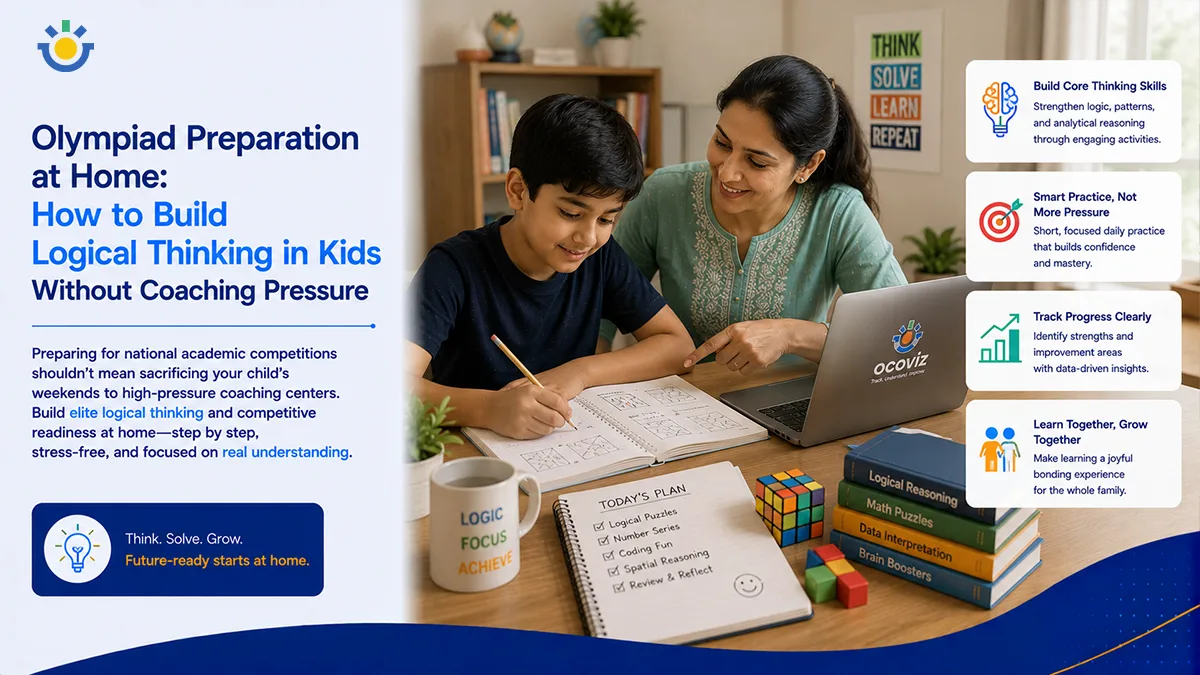
Imagine your child coming home from school, opening a digital dashboard on their tablet, and voluntarily jumping into a series of interactive logical puzzles called "Brain Battles" or "Weekly Sprints." No heavy stacks of test-prep books, no exhausting commutes to weekend coaching centers, and absolutely none of the high-pressure anxiety of "topper culture."
For most parents, this sounds like a distant dream. In reality, preparing for national Olympiads often feels like a high-stakes chore. We want our children to develop advanced analytical skills, but we hate watching them burn out under the stress of rigorous tutoring regimens that treat young minds like exam-taking machines.
But what if the traditional exam prep model has it all backward? What if the key to building true, national-level cognitive strength isn't intensive test training at all, but rather cultivating a daily, low-stakes curiosity right in the comfort of your living room?
The Direct Answer
Effective Olympiad preparation at home focuses on building foundational logical thinking through consistent, low-stakes cognitive challenges rather than rote memorization. By utilizing a self-paced, active-learning system that highlights personalized focus areas and offers step-by-step pedagogical guidance, children can build elite competitive readiness entirely without the pressure of traditional coaching.
Is coaching really necessary for Olympiad exams?
The coaching industry has convinced millions of parents that passing competitive academic exams requires professional, high-pressure tutoring. But traditional coaching centers often rely on rote drilling—teaching kids how to memorize specific patterns of questions to pass a test, rather than teaching them how to think.
When competitive readiness is stripped of stress and brought home, it shifts from a chore into a rewarding climb. High-level cognitive benchmarking is entirely possible at home when students are supported by structured, child-friendly learning pathways instead of passive lecture sheets.
Phase 1: Re-imagining the entry point to remove test anxiety
If you hand a ten-year-old a mock Olympiad paper, they will likely feel overwhelmed and disengaged. Fear of failure is the number-one killer of academic confidence.
To solve this, a student's competitive journey should start with discovery, not testing. Instead of facing dry, intimidating "Exam Registrations," kids should be introduced to highly engaging, gamified entry points:
- Logic Arenas: Small, visual puzzles that feel like play but test deep deductive reasoning.
- Brain Battles: Short, competitive matchups that turn cognitive skills into friendly challenges.
- Concept Quests: Weekly, theme-based adventures built to spark natural scientific curiosity.
Traditional Prep > Intimidating Mock Exam > High Anxiety & Disengagement
Ocoviz Masters > Playful Logic Arenas > Low-Stakes Curiosity & Engagement
By keeping the initial entry point completely low-stakes, the system silently assesses a child's natural strengths, consistent habits, and curiosity patterns without triggering any exam anxiety.
Phase 2: Building daily mastery through "explaining-first" guidance
Once a child is excited to learn, how do they bridge the gap between basic schoolwork and advanced, national-level problem-solving? This is where standard self-study often falls short—when a student gets stuck on a complex problem at home, they have no one to guide them.
This is where the Ocoviz Masters ecosystem introduces a game-changing dynamic. When a child encounters a bottleneck on their dashboard, it is flagged as a personalized Focus Area.
Instead of leaving the student frustrated, they can click on Guided Help to connect with a dedicated AI Co-Pilot tailored specifically for that subject.
Phase 2: Building daily mastery through "explaining-first" guidance
Once a child is excited to learn, how do they bridge the gap between basic schoolwork and advanced, national-level problem-solving? This is where standard self-study often falls short—when a student gets stuck on a complex problem at home, they have no one to guide them.
This is where the Ocoviz Masters ecosystem introduces a game-changing dynamic. When a child encounters a bottleneck on their dashboard, it is flagged as a personalized Focus Area.
Instead of leaving the student frustrated, they can click on Guided Help to connect with a dedicated AI Co-Pilot tailored specifically for that subject.
Student Dashboard: Flagged Focus Area > Guided Help > Dedicated AI Co-Pilot Opens
These Co-Pilots are trained on advanced pedagogy to ensure they never simply give away the answer. Instead, they use a highly supportive, step-by-step guiding method:
- First, they explain the concept: They teach the underlying rule or method behind the question.
- They provide scaffolding clues: They drop small hints to help the child make connections.
- They let the student solve it: The student takes the final step, experiencing the immense confidence boost of finding the solution themselves.
Phase 3: Shifting from flat rankings to holistic "Masters Indexing"
Traditional Olympiad organizations focus entirely on a single metric: your final rank. Telling a child they came "Rank 472" doesn't teach them anything about their cognitive habits. It simply tells them they weren't the best.
A modern, supportive competitive ecosystem replaces the flat, discouraging rank with a multidimensional Masters Index.
THE MASTERS INDEX: Logical Strength + Analytical Thinking + Speed Efficiency + Competitive Confidence
This psychological shift changes how a child views their progress. They aren't just competing against thousands of other test-takers; they are actively monitoring their own analytical growth, consistency, and speed. Success is no longer reserved for a single "topper" on a podium—every student can earn prestigious titles like Subject Master, Deep Thinker, or Consistency Champion.
Practical Takeaways
- Swap drills for logic games: Dedicate 15 minutes of daily study time to puzzle-solving or logic-based riddle games instead of dry test papers.
- Ban copy-paste answer keys: When your child gets a question wrong, hide the direct solution. Encourage them to explain their thinking process to you out loud first to find the logic gap.
- Focus on cognitive progress: When celebrating study sessions, praise their focus, their creative problem-solving methods, and their consistency rather than just their score.
- Leverage Ocoviz Masters: Introduce your child to a supportive, parallel academic excellence platform where they can learn at their own pace with step-by-step AI Co-Pilot guidance.
Conclusion
Preparing for national academic excellence does not require a trade-off with your child’s emotional well-being. When we bring Olympiad-level learning home—supported by gamified discovery, diagnostic Focus Areas, and patient, guiding Co-Pilots—we strip away the toxic pressure of coaching classes. We replace it with something infinitely more powerful: a genuine love for deep, independent problem-solving that will serve them for a lifetime.
Frequently Asked Questions
How does Ocoviz Masters prepare students for national Olympiads without standard coaching?
What are "Brain Battles" and "Logic Arenas"?
How do Ocoviz subject-specific AI Co-Pilots differ from generic AI chat tools?
What is the "Masters Index" and why is it better than a traditional ranking?
Does my child need to be a top student to participate in Ocoviz Masters?
How do school leaders and teachers view the Ocoviz Masters ecosystem?
How can parents track their child's independent progress on the platform?
Ready to build elite logical thinking without the stressful coaching?
Discover how Ocoviz Masters uses gamified challenges, personalized Focus Areas, and expert AI Co-Pilots to prepare students for national-level success.
Book a Live Demo