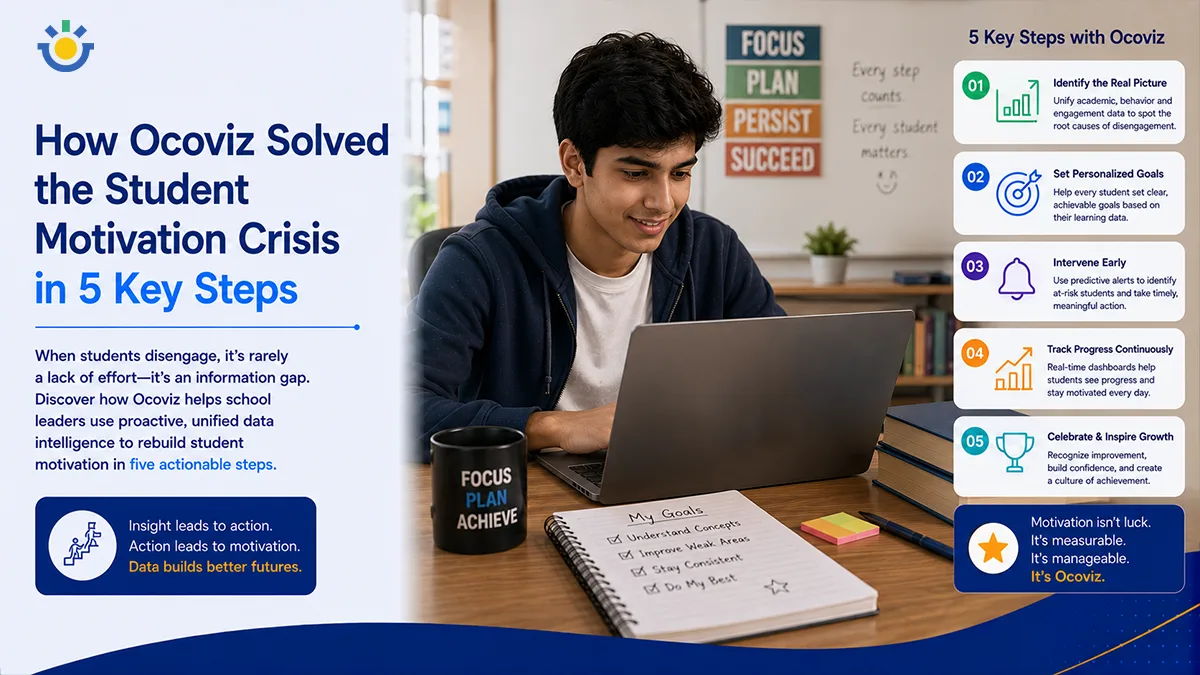
How Ocoviz Solved the Student Motivation Crisis in 5 Key Steps
Walk down any school corridor, and you will likely hear a familiar lament in the staffroom: "The students just aren't motivated anymore."
It is easy to blame smartphones, changing attention spans, or a post-pandemic shift in work ethic. But when we look closer at the students who seem to have given up, a different story emerges. These students aren't lazy; they are exhausted by a system that only notices their struggles after they have already failed.
Imagine trying to navigate a dark room where you only find out you’ve hit a wall after the bruise forms. That is what school feels like for a struggling child. By the time a report card is printed or a parent-teacher meeting is called, the student has already checked out to protect their self-esteem.
To solve the student motivation crisis, we have to stop treating motivation as a personality trait. Instead, we must treat it as a direct byproduct of clarity, early support, and timely recognition.
The Direct Answer
Schools can solve the student motivation crisis by shifting from reactive grading to proactive, data-driven intervention. By unifying academic, attendance, and behavioral data, educators can identify disengagement weeks before academic failure occurs, pinpoint exact learning gaps, and deliver targeted encouragement when it matters most.
Why are traditional schools struggling to keep students engaged?
Most school management systems act as digital filing cabinets. They record historical failures—absences, low test scores, and disciplinary infractions—after they happen.
By the time this data is compiled, analyzed, and handed to a teacher, weeks have passed. The student has already internalized the idea that they "just aren't good at this." This lag in information creates a cycle of learned helplessness, where students stop trying because effort feels disconnected from success.
Step 1: How do we catch silent disengagement before it affects grades?
The earliest signs of academic struggle are incredibly subtle. They exist in micro-behaviors that are easily missed in a busy classroom of forty students.
A student doesn't drop from an A to an F overnight. Instead, they submit an assignment twelve hours late. Their weekly attendance slips by 5%. They stop participating in class discussions.
To catch these signals, school leaders are turning to Ocoviz, a Learning Intelligence Operating System (LIOS). The system continuously monitors these quiet micro-behaviors, flagging "at-risk" students two to four weeks before a major academic dip occurs. This allows teachers to step in with gentle, proactive guidance before a student ever experiences the demoralizing sting of a failed exam.
Step 2: Are students actually unmotivated, or are they just lost?
When a student studies hard for a math test and still fails, their drive to try again plummets. In most cases, this happens because they are practicing the wrong things due to a hidden conceptual gap—like trying to master algebra while still struggling with basic fractions.
Without precise diagnostics, homework feels like blind effort. The ecosystem solves this by analyzing the exact thinking patterns behind a student's answers, rather than just marking them right or wrong.
When a teacher can pinpoint the exact foundational block that is missing, the conversation changes. The student realizes they don't lack intelligence; they simply need to patch one specific gap.
Step 3: How can we help busy teachers give meaningful praise?
Every educator wants to encourage their students, but administrative overload makes personalized recognition incredibly difficult to scale.
When praise is generic, students see right through it. To truly motivate, feedback must be specific and timely.
System Update: Grade Rebound : "Ananya's science quiz scores improved by 15% this week. Take 30 seconds to acknowledge her effort after class today."
By processing daily classroom data, the software delivers automated, prioritized recommendations directly to a teacher's dashboard. These quick prompts make it easy for educators to offer highly specific validation, turning routine data entry into moments of genuine human connection.
Step 4: What happens when school-to-home communication is only negative?
For many struggling students, a phone call from the school to their parents is a source of anxiety. When communication between home and school only occurs during a crisis, it turns the home into a high-pressure environment that further drains the child's motivation.
To break this cycle, the cloud infrastructure automates balanced, multi-channel updates for parents. By celebrating small, consistent wins—such as a streak of improved attendance or a sudden rebound in a tough subject—constructively alongside early warnings, the home environment shifts from a place of stress to a constructive support system.
Step 5: How do we celebrate the whole student, not just test scores?
Reducing a student's entire school identity to a single percentage on a report card is a fast track to disengagement for anyone who isn't at the top of the class.
Schools must look beyond academic metrics to find what makes a student tick. Our unified platform integrates academic performance with library reading trends, co-curricular participation, and school engagement into a single, holistic student profile.
When school leaders can see and celebrate a child’s passion for creative writing or leadership on the sports field, the student feels deeply seen, keeping them anchored to the school community.
Practical Takeaways
To begin rebuilding student motivation in your school this week:
- Shift the feedback timeline: Ensure students receive bite-sized, formative feedback within 48 hours of an assessment, rather than waiting for monthly reports.
- Establish a "Warm Call" routine: Challenge teachers to make two positive parent communications for every one corrective flag they raise.
- Track engagement metrics: Look at weekly assignment submission rates and consecutive absences as leading indicators of academic health.
- Highlight non-academic growth: Dedicate five minutes of your weekly school assembly to celebrate progress, resilience, and character, not just top marks.
Conclusion
Student motivation is not a finite resource that kids either have or lack. It is an active state of mind built on clarity, timely support, and feeling valued. By moving away from reactive tools and embracing a proactive approach to school intelligence, we can ensure that no student falls through the cracks silently.
Frequently Asked Questions
What are the main causes of the student motivation crisis?
How does early detection prevent students from giving up?
How can school software help teachers build stronger relationships with students?
Why do traditional report cards fail to motivate struggling learners?
How can a learning intelligence operating system identify hidden learning gaps?
How does positive parent communication affect a student's performance?
Why is it important to track non-academic data for student engagement?
Is it difficult for teachers to adopt a data-driven system like Ocoviz?
Turn Raw School Data into Student Success Stories
Discover how our Learning Intelligence Operating System can help your school leadership team spot disengagement early, support teachers, and keep every student motivated.
Schedule a Live Demo