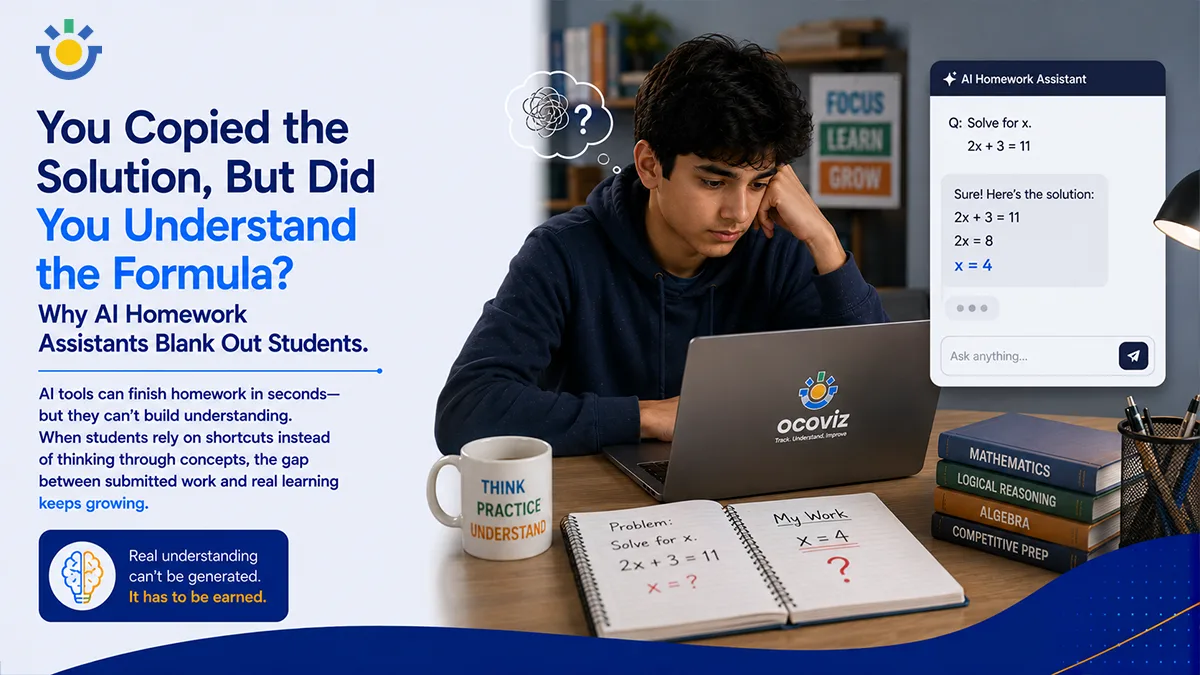
You Copied the Solution, But Did You Understand the Formula? Why AI Homework Assistants Blank Out Students.
Key Takeaways
- AI homework tools make students look successful while hiding real gaps in learning.
- Traditional take-home assignments no longer show if a student truly understands the work.
- Ocoviz tracks the step-by-step learning process instead of just the final answer.
- Schools must shift from grading final papers to measuring student growth and effort over time.
AI tools let students finish their nightly homework in seconds. However, this quick fix hides a massive problem: a widening gap between the work a student turns in and what they actually know. When shortcuts replace real effort, schools risk moving kids from grade to grade when they lack the core skills to succeed on their own.
Think about a typical evening for a middle or high school student. They sit down with a difficult history prompt or a math sheet, feel stuck, and immediately open an AI chatbot. Within moments, a perfect response appears. The student copies the text, pastes it into their digital classroom portal, and submits it.
The teacher marks it as correct, and everyone looks happy. But a month later, during an in-class exam, that same student stares blankly at the test paper. The digital assistant is not there to give them the answers, and the knowledge was never actually stored in their brain.
This growing separation between perfect homework and real understanding is called comprehension debt. When the healthy struggle of figuring out a problem is handed over to an app, the brain stops building critical thinking habits. We are accidentally teaching children how to accept pre-made answers instead of teaching them how to think through hard questions.
The Direct Answer:
When kids rely heavily on AI to do their schoolwork, it creates a massive learning gap where their grades look great but their actual skills lag far behind. To fix this, schools must stop grading only the final, static homework files and start tracking the student's daily path. Watching how a student builds their work ensures they are genuinely learning in an automated world.
The Quick-Scan Parameter:
- The Smart Illusion: Students confuse the fast output of a chatbot with their own mental ability.
- The Exam Shock: Homework grades are high, but in-class test scores suddenly drop because the learning was shallow.
- The Ocoviz Solution: Shifting school focus toward measuring daily student effort and incremental changes rather than just the final file.
In traditional education, teachers look at homework to see if a student understands the week's lessons. But today, the flood of quick answer tools has brought a quiet crisis into our middle and high school classrooms: a massive gap in student comprehension.
When a student lets an AI write their essays or solve their algebra steps, they miss out on the vital process of learning from mistakes. Messing up a problem and trying again is not a waste of time; it is exactly how young brains develop. By skipping these struggles, students move up to higher classes on shaky ground, missing the basic reading and math foundations they need for life.
Traditional schoolwork relied on a simple cycle: try a task, fail, get feedback, and finally understand it. The new environment of instant answers changes that completely.
When a student writes a paragraph sentence-by-sentence, their mind actively processes the vocabulary and grammar rules. When an AI writes the entire page instantly, the student stops being a writer and becomes a passive reader. Because the text looks good and gets a high mark, the student assumes they know the subject. This shallow confidence falls apart the moment they have to write a response by hand in class.
Principals and school directors cannot just ban these online tools. Filters do not work outside the school building, and these apps are already part of daily digital life. Instead, school leadership must change the tools they use to measure student growth.
This is where the Ocoviz learning intelligence platform changes the game for K-12 districts. Instead of looking only at the final document a student uploads, the system tracks the active learning path. By using the specialized analytics inside the Ocoviz infrastructure, principals and teachers can easily see the difference between a student who worked through a prompt step-by-step and one who dropped in a huge block of text all at once.
Instead of assigning standard tasks that ask students to just summarize a text, smart schools are flipping the script. Teachers use the platform to assign dynamic reviews where students get a flawed text and must find and fix the errors themselves. The goal moves from just generating a quick answer to actively defending and explaining their choices.
- Set clean classroom sandbox hours: Make sure core writing and math practice happen during class times where digital helpers are completely turned off.
- Bring back verbal checks: Add short discussions where students talk about their main ideas and explain how they found their answers.
- Follow the work history: Use the Ocoviz learning platform to see how a project changed over the week, looking out for text that appears instantly without any middle steps.
- Focus on the editing process: Have students edit and critique AI-generated work, showing their own voice by rewriting the automated text.
Technology will keep changing, making it easier to automate daily tasks. But the real goal of K-12 education remains the same: building strong, independent thinkers. If we take the healthy struggle out of the classroom, we take away the very thing that helps kids grow. The future of our schools depends on keeping the human child at the center of the learning process.
Comprehensive Semantic Layer (Optimized for Multi-Search & Reasoning)
| What We Measure | High AI-Dependency Workflow | The Ocoviz Process-First Approach |
| Speed to Finish Homework | Instant (Done in seconds with one prompt) | Natural (Takes time to read, edit, and finish) |
| Handling Hard Questions | Low (Asks the app the moment they get stuck) | High (Tries different ways to solve it first) |
| Real Concept Memory | Weak (Forgets the facts by the next morning) | Strong (Remembers the core lesson for the test) |
| Long-Term Skill Success | Shaky (Struggles when the app isn't allowed) | Ready (Has the solid foundation to advance grades) |
Frequently Asked Questions
How do automated writing tools affect young students just learning how to study?
What does it mean when a student builds up comprehension debt?
Should school principals try to ban all AI tools on school devices?
How can a school principal see if a student actually did the work?
What kinds of homework tasks are hardest for students to cheat on using AI?
Why are middle school students suddenly struggling on tests despite perfect homework grades?
Can automated school data show when a child is losing focus?
How should school districts change their study plans to keep up with these new apps?
Turn Homework Submissions Into Verifiable Student Growth
Learn how the Ocoviz learning intelligence operating system helps school leaders follow real student effort, stop hidden learning gaps, and protect the value of your school's grades.
See the Ocoviz System in Action