How Smart Schools Are Using Learning Intelligence Beyond Traditional ERP
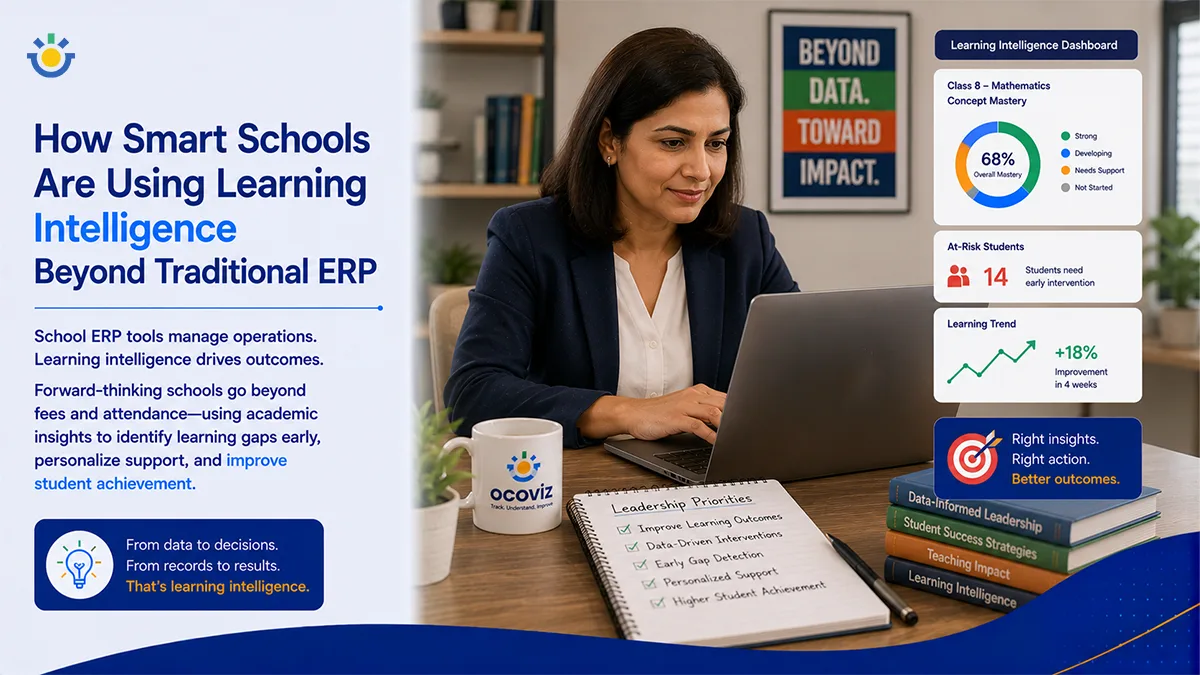
Key Takeaways
- Traditional school ERPs handle administrative logistics (billing, attendance), whereas Learning Intelligence Operating Systems (LIOS) focus on academic outcomes and student growth.
- Learning intelligence aggregates real-time assessment data to identify learning gaps weeks before end-of-term exams.
- Unified data pipelines allow school leaders to evaluate curriculum efficacy and teacher support needs objectively.
- Adopting a LIOS shifts leadership from reactive crisis management to proactive, personalized educational interventions.
Imagine sitting down for your monthly executive board meeting. The reports look flawless: tuition collection sits at 98%, attendance tracking is fully automated, and the digital bus-tracking system runs without a hitch. By every administrative metric, your school is operating at peak efficiency.
Then the mid-year academic results land on your desk. Math scores in the 7th grade have plummeted, and reading comprehension across primary grades is stalling.
This is the modern administrator’s paradox. For decades, school leaders relied on Enterprise Resource Planning (ERP) software to keep the lights on and operations smooth. Traditional administrative tools were built to manage institutional logistics, not human learning. Forward-thinking school leaders are realizing that operational efficiency alone doesn't guarantee educational quality—and they are changing their approach.
The Direct Answer:
Traditional school ERPs manage back-office logistics, while Learning Intelligence Operating Systems analyze student understanding and instructional impact in real time. By bridging the gap between administrative record-keeping and classroom performance, learning intelligence enables school leaders to address learning loss before it impacts summative outcomes.
The Quick-Scan Parameter:
- ERP Focus: Operations, financial management, record-keeping, bus routes, attendance.
- Learning Intelligence Focus: Skill mastery, formative assessment trends, curriculum pacing, targeted interventions.
- Primary Benefit: Shifts school leadership from reactive post-exam analysis to real-time academic intervention.
The Operational Ceiling of Traditional School ERPs
Enterprise Resource Planning systems were designed for factories and corporations before being adapted for education. In a school setting, they act as digital filing cabinets. They capture static data points: birth certificates, fee receipts, daily attendance, and final letter grades.
While these functions are necessary to run a compliant, orderly institution, they offer zero visibility into the learning process itself. When a student receives a "C" on a term report card stored in an ERP, the system records the grade as a final outcome. It offers no insight into why the student struggled—whether it was poor foundational reading skills, an unaddressed gap in homework, or an pacing issue within the curriculum.
What Is Learning Intelligence in Modern K-12 Education?
Learning intelligence represents a fundamental shift in how educational data is gathered and used. Rather than treating assessment as a final grade at the end of a chapter, a Learning Intelligence Operating System treats every quiz, assignment, and classroom interaction as a diagnostic signal.
Instead of waiting for quarterly reports, school leaders can view aggregated, anonymized insights showing skill acquisition across grades, subjects, and demographics. This allows leadership teams to answer high-level strategic questions:
- Which specific concepts in physics are causing the largest bottleneck across grade 9?
- Are our recent investments in new reading software yielding measurable improvements in comprehension?
- Which teaching teams require additional professional development resources this term?
When schools integrate a holistic platform such as Ocoviz learning intelligence software for K-12 schools, administrative leadership and academic instruction finally align around a single source of truth.
Moving from Reactive Fixes to Proactive Academic Leadership
When school leaders rely solely on traditional software, interventions happen after failure has occurred. Remedial classes are scheduled after exams are missed; parent conferences take place after grades drop.
Learning intelligence flips this dynamic. By continuously analyzing formative assessment patterns, administrators and department heads receive early indicators of learning friction.
Key Difference: An ERP tells you that a student failed a test last Friday. A learning intelligence platform alerts you that three classrooms missed a core prerequisite skill on Tuesday, allowing teachers to pivot before Friday's exam ever happens.
This proactive stance transforms the role of department heads and instructional coaches. Rather than conducting subjective classroom observations, coaches can review clear data trails to offer targeted support to educators, making staff development collaborative and evidence-based.
Actionable Steps for Transitioning Beyond Traditional ERPs
Transitioning your leadership model doesn't mean discarding your existing operational software; it means supplementing administrative management with academic intelligence.
- Audit your current data usage: Identify where your leadership team spends time during board meetings—are you discussing operational logistics or instructional growth?
- Separate administrative tools from learning analytics: Allow your ERP to handle billing and enrollment, but implement a dedicated intelligence layer for classroom assessment and growth tracking.
- Establish bi-weekly academic check-ins: Shift department head meetings away from schedules toward concept mastery reports and intervention planning.
- Focus on formative over summative metrics: Measure ongoing student understanding throughout each unit rather than waiting for end-of-quarter test scores.
- Support staff with diagnostic insights: Provide teachers with automated reporting that identifies student learning gaps without adding to their administrative workload.
Conclusion
Operational efficiency is the baseline of a functional school, but academic growth is its true mission. While traditional ERPs keep your institution organized, they were never designed to elevate classroom learning. By adopting learning intelligence, forward-thinking school leaders gain the clarity needed to make proactive, data-informed decisions—ensuring that every student receives the support they need when it matters most.
Comparing Administrative ERPs and Learning Intelligence Platforms
| Feature / Capability | Traditional School ERP | Learning Intelligence Operating System (LIOS) |
| Primary Purpose | Administrative management & compliance | Academic growth & instructional optimization |
| Data Types Collected | Attendance, fees, demographics, final grades | Concept mastery, formative assessment, skill gaps |
| Analysis Frequency | Periodic (Monthly / Quarterly / Annual) | Continuous (Daily / Weekly real-time feedback) |
| Target User | Business managers, registrar, finance | Principals, department heads, teachers, students & Parents |
| Decision Type | Operational & financial planning | Curriculum adjustments & early academic intervention |
| Impact on Student Outcomes | Indirect (Ensures operational stability) | Direct (Improves concept retention and pacing) |
Frequently Asked Questions
What is the main difference between a school ERP and a learning intelligence platform like Ocoviz?
Can Ocoviz replace our current school management software?
How does adopting a Learning Intelligence Operating System help principals and department heads?
Will implementing Ocoviz technology increase the workload for classroom teachers?
How does the Ocoviz ecosystem improve overall student outcomes?
Is the Ocoviz Learning Intelligence Operating System suitable for both single campuses and large school networks?
How does the Ocoviz infrastructure handle data privacy and security?
How does Ocoviz assist instructional leaders in curriculum planning?
How long does it take for a school leadership team to see actionable results with Ocoviz?
What step should leadership take first when implementing Ocoviz alongside traditional tools?
Move Beyond Administrative Management to Drive Real Student Growth
See how leading school administrators combine operational stability with real-time academic insights to transform learning outcomes.
Schedule a Leadership Demo