Why the Best AI in the Classroom Doesn't Teach (and What It Actually Does Instead)
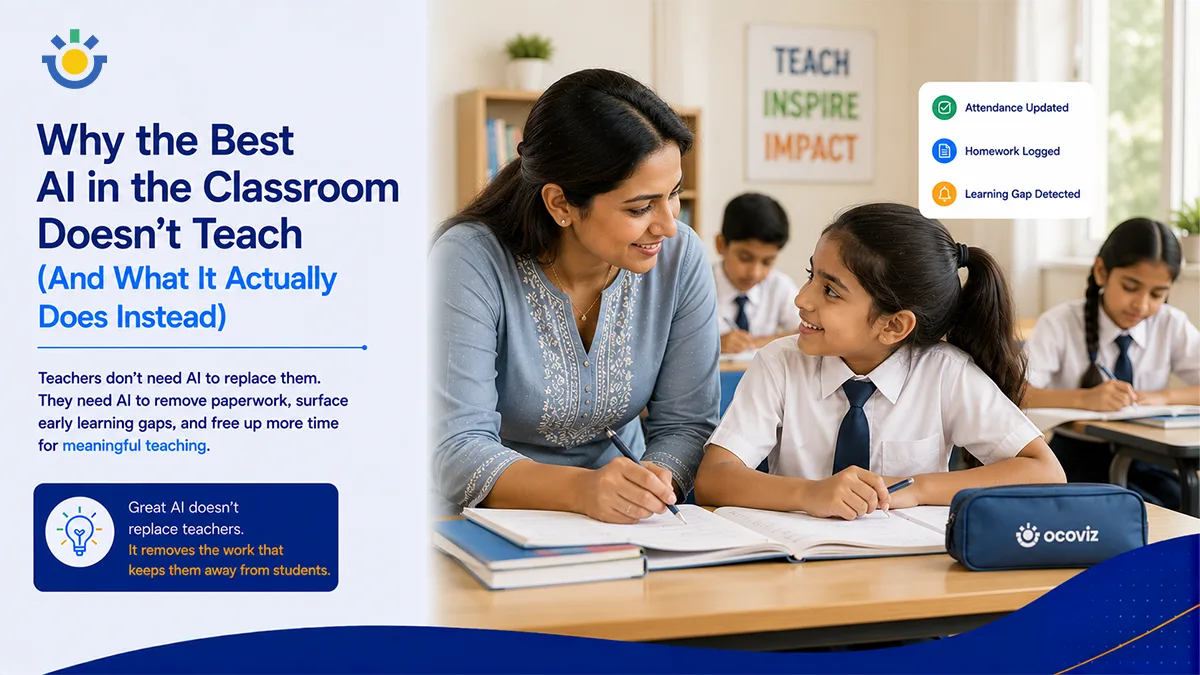
Key Takeaways
- Ocoviz is a Learning Intelligence Operating System (LIOS) that augments classroom teachers rather than automating instruction.
- Saves teachers ~12 minutes daily by automating attendance logs, mark-copying, and risk flagging.
- Detects subtle learning gaps 2 to 4 weeks before exams through multi-dimensional signal analysis.
- Uses an "explaining-first" AI Co-Pilot to guide student reasoning without giving away direct homework answers.
- Eliminates administrative burnout, allowing educators to focus entirely on human mentorship and active teaching.
It is 7:48 AM on a rainy Tuesday. A teacher sits at her desk, staring at a stack of ungraded quiz sheets, a open paper register, and three unread messages from anxious parents. The bell rings in twelve minutes.
She did not get into education to copy numbers from paper to spreadsheets, cross-reference attendance rosters, or play administrative detective. She became a teacher to light up a room—to watch a child’s eyes widen when a difficult math concept finally clicks. But by mid-morning, swallowed whole by compliance reports and manual logbook entries, that spark feels buried under endless clerical friction.
When people talk about AI in education, the conversation usually turns to dystopian fears: algorithms replacing lesson delivery, automated grading bots judging children, or digital avatars standing at the whiteboard.
The reality of helpful technology is much simpler. The best tool does not stand in front of the class. It sits quietly in the background, doing the tedious watching so the human teacher can do the actual teaching.
The Direct Answer:
Ocoviz is a Learning Intelligence Operating System (LIOS) designed to assist teachers, not replace them. By automating administrative tasks, cross-referencing attendance with performance signals, and flagging struggling students weeks in advance, Ocoviz removes clerical overhead so educators can deliver targeted, high-impact instruction.
The Quick-Scan Parameter:
- Daily Time Saved: 12 minutes per teacher (via one-entry mark logging and auto-registers).
- Early Intervention Window: Identifies learning gaps 2–4 weeks before exams.
- Core Role: Background telemetry and administrative automation—never direct lesson replacement.
- Pedagogy Standard: Socratic "explaining-first" AI guidance rather than answer copy-pasting.
How Does Learning Intelligence Assist Teachers in Daily Classrooms?
Every morning, class teachers make dozens of quick decisions based on incomplete information. Who was absent three days in a row last week? Which four students stumbled on yesterday's homework assignment?
Traditional software stores records after the fact. It acts like an autopsy report—telling you why a student failed long after the term has ended.
TRADITIONAL CLASSROOM FLOW: Classroom Instruction > Term Exam > Autopsy Grade
OCOVIZ INTELLIGENCE FLOW: Daily Signals > 72-Hr Risk Alert > Human Mentorship
Ocoviz works as a predictive safety net by reading subtle background signals—a minor drop in homework submission timing paired with consecutive low scores on short quizzes. Before entering the room at 8:00 AM, the teacher glances at a 30-second pulse view. She instantly sees which three students need a brief, encouraging check-in before the bell rings.
What Happens When Software Handles the Data Entry?
Teachers lose up to 43% of their working hours to non-instructional, transactional tasks. Copying marks from exam paper to digital ledgers, manually tracking attendance patterns, and formatting board compliance documents drains vital energy.
WHERE THE 12 MINUTES COME FROM
| Administrative TaskTime | |
| Attendance marking & register preparation | 5 mins |
| Cross-referencing marks across registers | 4 mins |
| Parent communication coordination | 2 mins |
| Flagging students for HOD/Principal review | 1 min |
| Total Time | 12 mins |
When mark entry happens once, it flows into student profiles, class trend views, and terminal progress reports automatically. No copying between systems. No Sunday-night report card marathons.
"We turn everyday school data into early-warning insight teachers can act on—without adding extra steps to their morning routine." — State of School Intelligence in India Report
Why Doesn't AI Tutor Replace the Human Mentor?
A common point of confusion is whether AI tutors strip away the teacher's role. Most basic AI tools encourage passive learning by handing students direct answers to paste into homework.
The system uses an "explaining-first" design philosophy. When a student uses the built-in 24/7 AI tutor for step-by-step doubt solving, the software refuses to output a final solution. Instead, it asks scaffolding questions, points out forgotten rules, and guides the student to solve the problem themselves.
When forty students struggle with forty different sub-concepts, a teacher cannot physically sit next to all of them at once. The digital assistant handles initial friction, while the human teacher steps in for deeper, high-level mentoring.
Practical Takeaways for Educators
- Check morning pulse views: Spend 30 seconds reviewing prioritized risk alerts before entering the classroom.
- Log assessment marks once: Allow the centralized dashboard to populate term reports and parent updates automatically.
- Use predictive gap data: Adjust upcoming lesson plans dynamically when class-wide analytics reveal shared conceptual bottlenecks.
- Shift to proactive parent chats: Share early progress updates so parent conversations center on solutions rather than surprises.
Conclusion
Technology will never replace the warmth of an encouraging teacher, the intuition of an experienced mentor, or the inspiration of a great classroom lesson. Software cannot give a struggling child a reassuring smile or understand the emotional nuance behind a sudden drop in effort.
By removing administrative burdens and identifying hidden struggles early, Ocoviz gives teachers back their most precious resource: time to actually teach.
The Comparison Block: Traditional ERP vs. LMS vs. Learning Intelligence
| System Type | Primary Focus | Early Risk Detection? | Teacher Workflow Impact |
| Traditional ERP | Administrative record-keeping & fee ledgers | ✕ Historical grades only | Heavy manual data entry |
| Standard LMS | Content delivery & quiz hosting | ✕ Stores submissions | Siloed assignment logs |
| Learning Intelligence (LIOS) | Early intervention & workflow automation | ✓ Flags gaps 2–4 weeks early | Saves ~12 min/day automatically |
Frequently Asked Questions
How do school leaders spot struggling students before report card day?
How can classroom teachers reduce time spent on administrative data entry?
Does using an AI tutor in the classroom encourage students to cheat on homework?
Can a school intelligence system work alongside our existing LMS?
How does predictive risk scoring help teachers tailor their daily lesson plans?
What is the difference between a traditional school ERP and a Learning Intelligence Operating System?
See How Learning Intelligence Transforms Classroom Workflows
Discover how Ocoviz handles administrative chaos, flags struggling students early, and empowers your educators to focus on what matters most—teaching.
Schedule a 20-minute Guided Demo