Misconception Check: How Spotting Deliberate Mistakes Builds Unshakeable Student Mastery
Key Takeaways
- A "Misconception Check" is a targeted formative assessment where teachers intentionally present a false assumption, incorrect formula, or flawed logic for students to critique.
- Students must identify the specific error and write two sentences explaining the underlying conceptual breakdown.
- It tests analytical error-analysis, moving students beyond rote execution to deep diagnostic reasoning.
- Reviewing student explanations takes under 3 minutes, immediately exposing who understands the "why" behind a principle.
- Normalizing deliberate mistakes creates a culture of psychological safety where errors are treated as valuable learning opportunities.
You work through an example problem on the board. Step one, step two, step three—smooth, logical, and flawless. You turn around, ask if everyone understands, and see a sea of nodding heads. It feels like a successful lesson.
Then, ten minutes into independent practice, a student raises their hand. They made the exact same classic mistake you explicitly warned them against three minutes ago.
Nodding along while a teacher demonstrates flawless execution creates a dangerous illusion of competence. Students think they understand because the path looks obvious when someone else navigates it. But true understanding isn't proven by following a paved road—it's proven by recognizing when a turn leads off a cliff. The moment you intentionally hand them a flawed map and ask them to find the wrong turn, you find out who actually understands the territory.
The Direct Answer:
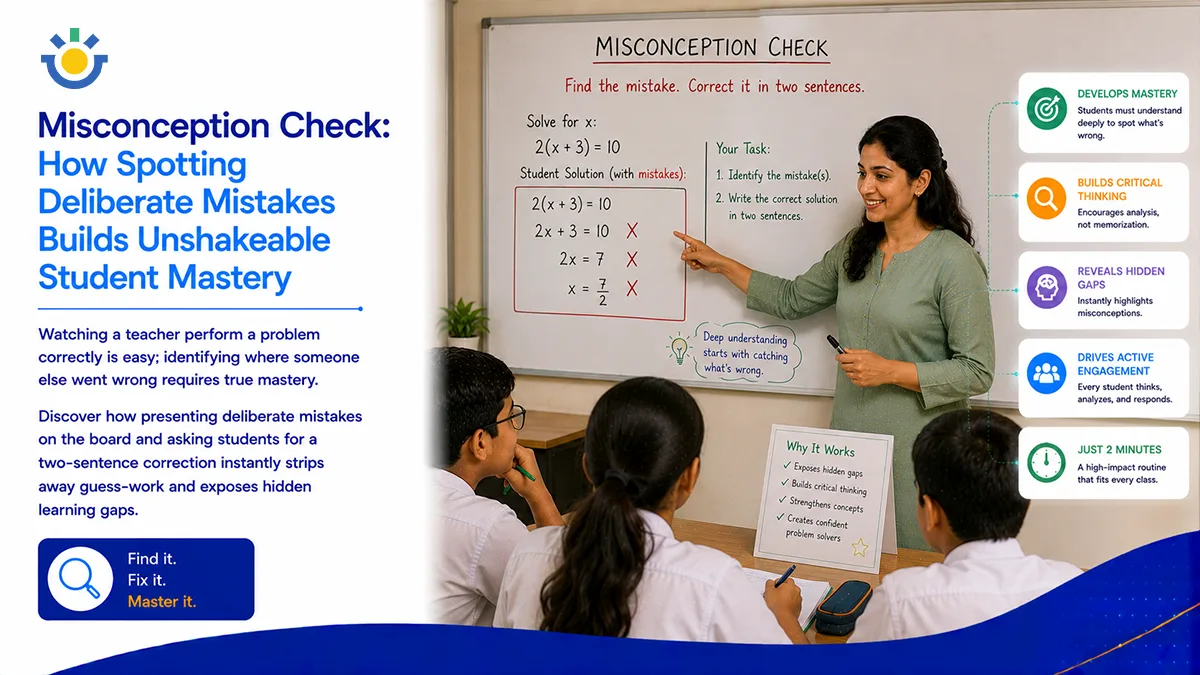
A Misconception Check is a high-rigor formative assessment strategy where teachers present a common false claim, incorrect calculation, or flawed logical step on the board. Students must spot the exact error and write a concise, two-sentence explanation detailing why the logic fails and how to correct it.
The Quick-Scan Parameter:
- Time required: 2 minutes to analyze and write; 1 minute to check.
- Required Output: Error identification + a 2-sentence logical correction.
- Target Focus: Common trap doors, subtle formula shifts, and frequent logical fallacies.
- Primary benefit: Forces active evaluation and stops students from blindly mimicking procedures.
Why Proactive Error Analysis Outperforms Passive Practice
Most traditional instruction follows a linear path: teach the correct rule, show correct examples, and assign correct procedures. But when students only ever see correct models, they remain completely defenseless against subtle trap doors on high-stakes exams.
The Misconception Check shifts the cognitive demand from execution to evaluation.
By presenting a deliberate error, you force students to run an internal diagnostic check: What rule was violated here? Why is this outcome impossible? How do I articulate the precise breakdown?
How to Run a 2-Minute Misconception Check
To make this routine effective, the error must be believable. Choose the exact misconception that half your class typically stumbles over on Friday's quiz.
1. Present the Flawed Model
Write a problem or statement on the board containing one deliberate, realistic error.
- Math/Science: Display a multi-step solution where step two secretly ignores the order of operations or drops a negative sign.
- Humanities: Display a statement like: "The American Revolution was caused primarily by the Boston Tea Party, which immediately led to the signing of the Declaration of Independence."
2. Enforce the 2-Sentence Boundary
Require a strict two-sentence structure to keep student writing concise and focused purely on logic:
- Sentence 1: Identify the exact step or assumption that is incorrect.
- Sentence 2: Explain the underlying principle that makes it wrong and state the correct logic.
- Flawed Model: $(x+y)^2 = x^2 + y^2$
- Exemplar Student Response: "The error occurs in assuming that exponents can distribute over addition. Exponentiation means multiplying the binomial by itself, which requires expanding the terms to get $x^2 + 2xy + y^2$."
3. Scan for the "Right Answer, Wrong Reason"
When reviewing responses, pay attention to students who spot the error but give incorrect justifications. Identifying that something is wrong is only half the battle; knowing why it is wrong is where true learning lives.
Scaling Diagnostic Intelligence Across Your School
Spotting misconceptions inside an individual classroom helps a teacher adjust tomorrow's entry point instantly. But when common logical traps repeat across entire subjects or grade levels, tracking those trends manually becomes a bottleneck.
When cohorts of students stumble over the same foundational trap doors year after year, tracking these diagnostic patterns through a centralized dashboard helps instructional teams intervene early.
By collecting these micro-diagnostic checks within a modern Learning Intelligence Operating System (LIOS), school leaders and department heads gain real-time visibility into student error patterns. Teachers can collaborate on common trap doors, align their questioning strategies, and ensure students build resilient, error-resistant mental models across every subject.
- Use real student errors: Anonymously showcase a common mistake from yesterday’s homework as the prompt to make the exercise authentic.
- Enforce the 2-sentence rule: Prevent rambling explanations by keeping the output strictly bounded to two clear, analytical sentences.
- Normalize mistakes publicly: Explicitly celebrate catching errors to lower anxiety and build a safe culture around learning from mistakes.
- Focus on the "Why": Reject answers that simply state "The answer should be 12" without explaining the broken rule that led to the wrong answer.
- Run as a warm-up or exit check: Use the routine at the start of class to reactivate prior knowledge or at the end to verify today's takeaway.
Conclusion
You don't truly know a rule until you understand why its opposite fails.
By introducing deliberate mistakes and asking your students to analyze the breakdown, you transform them from passive rule-followers into sharp, analytical thinkers who can spot, correct, and avoid errors for life.
Diagnostic Strategy Comparison Matrix
| Strategy | Completion Time | Cognitive Focus | Primary Output |
| Misconception Check | 2–3 Minutes | Error Analysis & Evaluation | 2-sentence critique & correction |
| The Muddiest Point | 2 Minutes | Self-Reported Confusion | Single point of personal friction |
| Student-Generated Questions | 3–4 Minutes | Assessment Design & Creation | 1 exam question + answer key |
| One-Sentence Summary | 2 Minutes | Core Synthesis & Compression | 1 compressed structural sentence |
Frequently Asked Questions
How can teachers track student progress without spending hours on spreadsheets?
What makes a Misconception Check different from a standard pop quiz?
How do instructional coaches identify learning trends across an entire department?
How do you help students who struggle to articulate why a mistake is wrong?
How does surfacing daily student confusion improve long-term test performance?
Can Misconception Checks be implemented digitally?
Turn Classroom Errors into Deep Conceptual Mastery
Discover how simple diagnostic routines and real-time pulse checks can elevate critical thinking across your entire school.
See How It Works