Application Cards: How One Index Card Proves Students Can Transfer Theory to Reality
Key Takeaways
- "Application Cards" are a formative assessment strategy where students write down one real-world application of a classroom principle or theory on an index card.
- It tests transfer of learning—moving beyond abstract memorization to practical, real-world execution.
- Collecting and sorting cards takes under 3 minutes, giving teachers immediate data on whether students can contextualize new concepts.
- The strategy surfaces common misconceptions early before students apply flawed logic to homework or summative exams.
- It bridges academic theory with everyday relevance, significantly boosting student engagement and intrinsic motivation.
You just finished teaching a masterclass on Newton’s Third Law, economic supply and demand, or psychological cognitive bias. You asked if anyone had questions, and the room was silent in that reassuring, "we get it" kind of way. Students copied the formulas, defined the key terms, and solved the sample problems on the board without breaking a sweat.
Then you ask one simple question: "Where did you see this exact principle in action outside of school yesterday?"
Crickets. Heads drop. Blank stares ripple across the rows.
The harsh reality of teaching is that abstract understanding doesn't automatically equal real-world transfer. A student can calculate an equation on paper while remaining completely blind to how that same math governs the world around them. If learning stays trapped inside the classroom walls, it isn't mastery—it's just academic mimicry.
The Direct Answer:
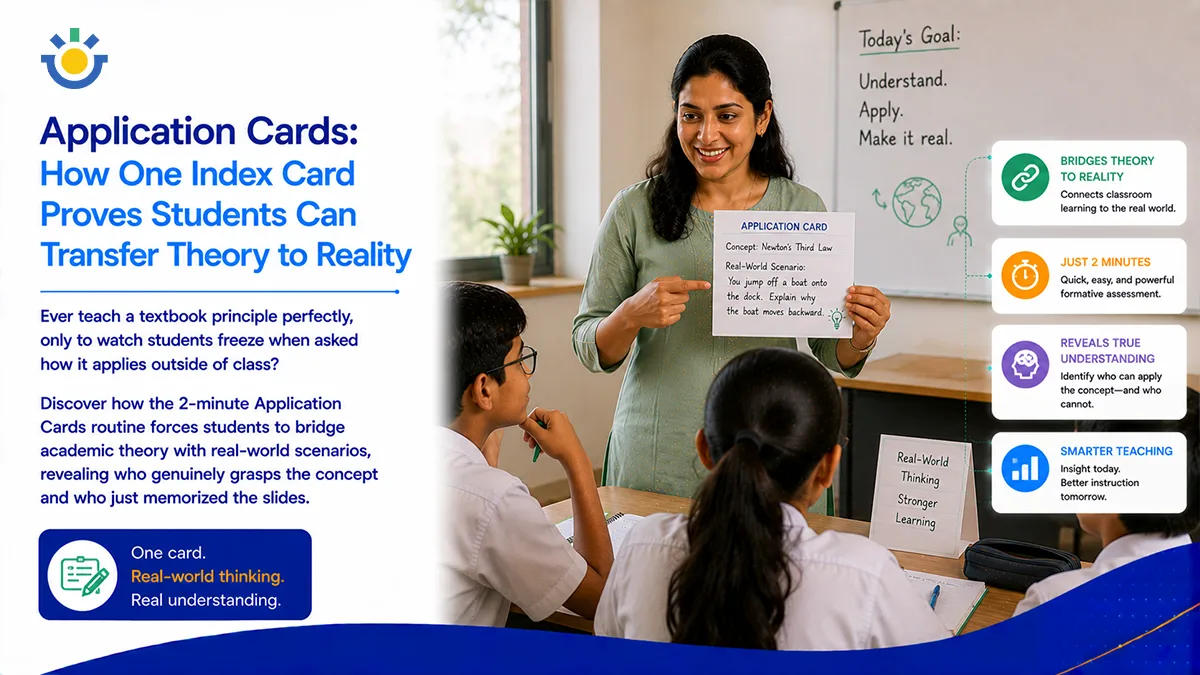
Application Cards are a quick formative check where students write down a single, concrete real-world application of a newly taught concept on a small index card. It tests cognitive transfer by requiring students to identify, generalize, and apply abstract classroom theories to practical, real-life scenarios.
The Quick-Scan Parameter:
- Time required: 2 minutes at the end of a lesson; 2–3 minutes to review.
- Materials needed: 3x5 index cards, sticky notes, or a digital form submission.
- Core Prompt: "Write down one real-world situation where this principle or rule operates."
- Primary benefit: Instantly proves if students can transfer abstract concepts to practical reality.
The Learning Transfer Gap (And Why It Matters)
Psychologists call the disconnect between knowing a concept and using it in context the transfer gap. Most traditional instruction focuses entirely on the internal logic of a subject—how step A leads to step B inside a lab or textbook.
Application Cards flip the lens outward. They force the brain to search its own mental library of real-world experiences and match them against the new academic model.
When a student successfully anchors a theoretical rule to a real situation, the concept settles into long-term memory. If they can't think of an application, it means they haven't actually understood the rule yet—they've only memorized its label.
How to Execute Application Cards in 3 Steps
The key to Application Cards is speed and specificity. You aren't asking for a mini-essay; you want a single, concrete example that proves the logic holds up.
1. Frame the Theory Explicitly
Before handing out the cards, clearly state the overarching rule, theory, or formula you want them to test.
"We just learned about the Law of Diminishing Marginal Utility. On your card, write down one specific personal experience where getting more of something made each additional unit less valuable to you."
2. Set the "No Textbook Examples" Rule
Ban any example that was featured in the textbook, slides, or class discussion. If you used sports tickets as your supply-and-demand example during the lecture, sports tickets are off-limits on their cards. This forces original, generative thinking.
- Weak/Repeated Example: "A rocket pushing gas down to go up." (Textbook classic for Newton's Third Law).
- Strong Original Transfer: "When I jump off a small wooden canoe into the lake, the canoe shoots backward away from me." (Original, concrete real-world observation).
3. The 3-Pile Diagnostic Scan
As students head out, collect their cards at the door. Do a quick 2-minute sort into three categories:
- Bullseye Transfer: Clear, accurate real-world applications that prove solid understanding.
- Superficial Transfer: Examples that use the right words but miss the underlying mechanism.
- Broken Logic: Examples where the student completely misapplied the principle, revealing a deeper misconception.
Scaling Practical Intelligence Across Your School
Scanning a stack of application cards lets a teacher quickly gauge if a single class period landed. But when whole departments struggle to help students transfer theoretical concepts to complex, real-world problems, physical index cards sitting on individual teacher desks aren't enough.
When real-world transfer gaps persist across grade levels, tracking these trends through a centralized dashboard helps instructional teams identify where learning is getting stuck in abstract silos.
By collecting these quick application checks within a modern Learning Intelligence Operating System (LIOS), school leaders and department heads gain real-time visibility into student Depth of Knowledge (DOK). Teachers can collaborate on cross-curricular applications, refine project-based learning units, and ensure students are building practical, real-world competency across every subject.
- Keep prompts narrow: Ask for a specific personal or real-world example rather than a general category to prevent vague answers.
- Ban repeated examples: Explicitly forbid students from reusing scenarios mentioned during the lecture or present in the textbook.
- Swap cards for peer evaluation: Have students trade cards with a neighbor to test if their partner's real-world scenario logically matches the theory.
- Highlight top applications: Start tomorrow's class by reading 2–3 of the most creative student-submitted real-world examples aloud.
- Use for STEM and Humanities: Apply the strategy beyond science and economics—use it in English ("Identify a real-world example of irony you saw this week") or History.
Conclusion
Education fails when it stays locked inside a notebook. The ultimate goal of teaching isn't just getting students to remember what we taught them—it's empowering them to see those principles working in the world around them.
By using Application Cards for just two minutes at the end of class, you help students build the bridge between abstract theory and real life, turning passive memorizers into observant thinkers.
Formative Assessment Strategy Matrix
| Strategy | Completion Time | Output Format | Primary Focus |
| Application Cards | 2 Minutes | Index card with 1 real scenario | Real-world transfer & contextual logic |
| One-Sentence Summary | 2 Minutes | 1 compressed structural sentence | Synthesis, precision, & core mechanics |
| The Muddiest Point | 2 Minutes | Single point of confusion | Immediate gap analysis & friction identification |
| Memory Matrix | 2 Minutes | Filled 2x2 or 3x3 grid | Categorization & relational retrieval |
Frequently Asked Questions
How can teachers track student progress without spending hours on spreadsheets?
What makes Application Cards different from standard reflection prompts?
How do instructional coaches identify learning trends across an entire department?
How do you help students who struggle to find a real-world example?
How does surfacing daily student confusion improve long-term test performance?
Can Application Cards be implemented digitally in modern classrooms?
Bridge the Gap Between Classroom Theory and Real-World Mastery
Discover how simple daily pulse checks and real-time reflection routines can elevate critical thinking across your entire school.
See How It Works