The 3-2-1 Exit Ticket: How a Simple 3-Tier Card Reclaims Your End-of-Class Routine
Key Takeaways
- The "3-2-1 Exit Ticket" is a structured formative assessment strategy where students reflect on three distinct tiers of learning before leaving class.
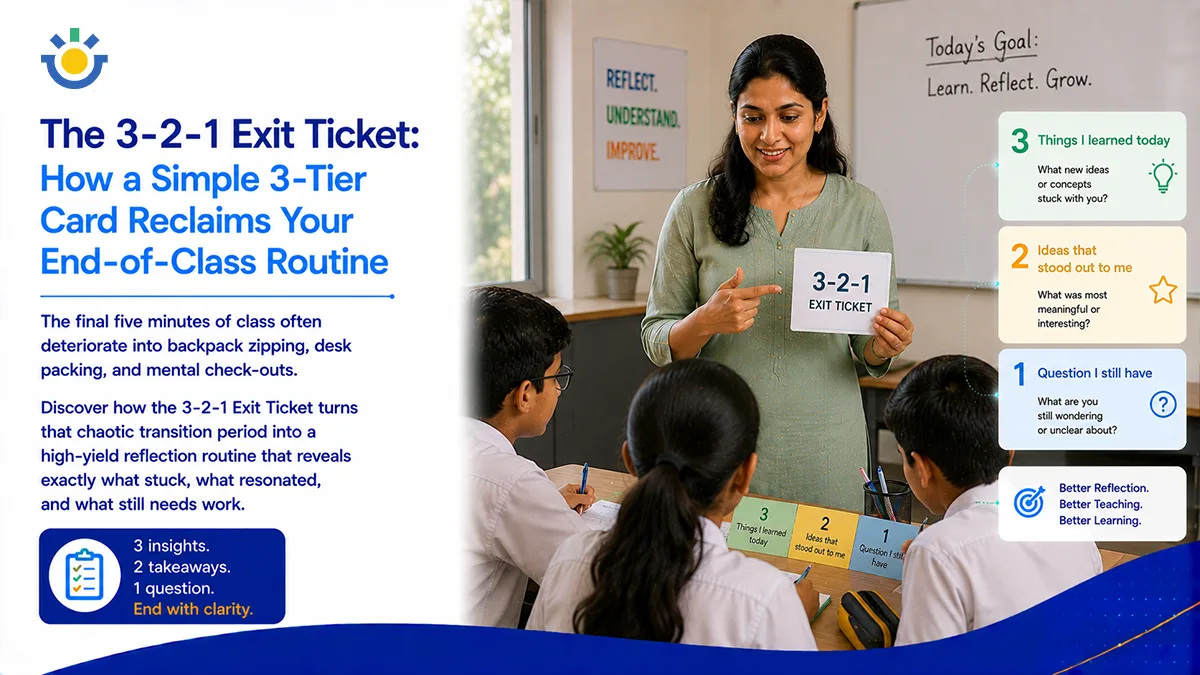
- The classic formula requires students to write down: 3 things they learned, 2 interesting facts or connections, and 1 unresolved question.
- It balances cognitive recall, personal engagement, and gap analysis in a single, low-stakes reflection routine.
- Sorting a stack of 3-2-1 cards takes under five minutes and provides actionable data to refine the next day's instructional entry point.
- The strategy builds self-directed reflection (metacognition) while lowering the anxiety associated with asking for help in front of peers.
It’s 2:40 PM. You have five minutes left on the clock. You finish your final slide, turn to the room, and announce, "Alright, start packing up!"
Instantly, total chaos erupts. Backpacks slam onto desks, zippers screech, chairs scrape against the floor, and conversations about weekend plans drown out whatever last-minute reminders you're trying to shout over the noise. By the time the bell rings, your students sprint out the door, leaving you standing in a cloud of dust, wondering if a single sentence from your lecture actually registered.
That frantic end-of-class rush isn't just exhausting—it's a massive wasted opportunity. Those final three minutes are the ideal moment to force a pause, quiet the room, and get a clear snapshot of what your students are taking home with them.
The Direct Answer:
The 3-2-1 Exit Ticket is a three-tiered end-of-class reflection routine where students write down 3 key takeaways, 2 interesting facts or real-world connections, and 1 remaining question. It combines active memory retrieval with personal synthesis and immediate gap analysis, giving teachers a complete picture of student comprehension before they walk out the door.
The Quick-Scan Parameter:
- Time required: 3 minutes for students to complete; 3–4 minutes for teacher review.
- Materials needed: Index cards, sticky notes, or a digital form template.
- The 3-2-1 Breakdown: 3 Learnings (Recall), 2 Connections (Engagement), 1 Question (Gap Analysis).
- Primary benefit: Drives structural metacognition while giving you precise data for tomorrow's warm-up.
Why Traditional Exit Tickets Fall Short (And Why 3-2-1 Works)
Most exit tickets fall into one of two traps. They are either too simple ("Did you understand today's lesson? Circle Yes or No"), which yields superficial answers, or they are overly demanding ("Solve these three complex multi-step word problems"), which turns the end of class into a stressful, rushed quiz.
The magic of the 3-2-1 structure lies in its progressive cognitive layering:
Instead of testing just one dimensional aspect of learning, it checks three distinct neural pathways: Retrieval (Tier 3), Relevance (Tier 2), and Self-Awareness (Tier 1).
How to Execute the 3-2-1 Routine in 4 Steps
Running this routine effectively requires protecting your instructional timeline. If you push it to the final thirty seconds, students will treat it like a tollbooth ticket they just want to hand you so they can escape to the hallway.
1. Freeze the Room at T-Minus 4 Minutes
Stop instruction four minutes before the bell. Instruct everyone to keep their desks clear except for their 3-2-1 card and a pen. No packing up, no zipping bags until the card is complete.
2. Standardize the Prompts
Keep the structure constant so students don't waste brainpower trying to figure out what you're asking for. Display the framework clearly on your screen:
- 3 Core takeaways from today’s lesson.
- 2 Interesting facts, real-world applications, or connections to prior knowledge.
- 1 Unresolved question, confusing detail, or wonder point.
3. The 4-Minute Stack & Sort
Collect the cards as students exit. During your prep period or at the end of the day, do a rapid scan. Sort the cards based primarily on Tier 1 (The 1 Question):
- The Clear Horizon: Cards with no questions or advanced "wonder" questions ("How does this apply to deep-space travel?").
- The Common Obstacle: The stack of 8–10 cards asking the exact same fundamental question about today's process.
- The Red Flag: Individual cards showing complete conceptual breakdown that require quick 1-on-1 check-ins tomorrow.
4. Close the Feedback Loop
Never collect exit tickets without acknowledging them the next morning. Start class by highlighting the top trends from Tier 2 and answering the biggest question from Tier 1. When students realize their cards directly dictate how class begins, their effort on the cards skyrockets.
Scaling Exit Intelligence Across Your Entire School
While physical index cards work seamlessly inside an individual classroom, tracking these three-tier reflections across departments or whole grade levels manually is nearly impossible.
When multiple teachers notice that students are struggling with the same foundational concepts across math and science, isolating those trends on paper takes too long.
This is where leveraging a modern Learning Intelligence Operating System (LIOS) reshapes instructional leadership.
By digitizing quick 3-2-1 checks, response patterns flow directly into a centralized dashboard. School leaders and instructional coaches can spot cross-subject hurdles, analyze student engagement trends, and help teachers refine their pacing before minor confusion turns into major learning gaps on summative exams.
- Use printed quarter-sheets: Having pre-printed lines labeled "3 - 2 - 1" provides visual structure and keeps responses concise.
- Vary the prompt focus: Tailor the "2" tier based on the subject (e.g., "2 vocabulary words you used today" or "2 historical causes").
- Validate the "1 Question": Explicitly praise thoughtful questions to eliminate the stigma around admitting confusion.
- Avoid grading for correctness: Treat the exit ticket strictly as formative diagnostic data; grading it ruins its low-stakes nature.
- Require an entry ticket follow-up: Use the common questions collected on yesterday's exit cards as the opening warm-up prompt today.
Conclusion
The end of a lesson shouldn't feel like a race against the bell. It should feel like a intentional landing.
By implementing the 3-2-1 Exit Ticket, you transform the last four minutes of class into a quiet, powerful routine that builds self-directed learners, eliminates end-of-class chaos, and gives you complete control over tomorrow's lesson plan.
Formative Assessment Strategy Matrix
| Strategy | Time Required | Primary Output | Best Used For |
| 3-2-1 Exit Ticket | 3–4 Minutes | Balanced Recall, Connections, & Questions | Comprehensive end-of-lesson reflection |
| The Muddiest Point | 2 Minutes | Single specific point of confusion | Immediate friction checks on hard concepts |
| The Minute Paper | 60 Seconds | Main takeaway & lingering question | Rapid synthesis checks under tight constraints |
| One-Sentence Summary | 2 Minutes | Compressed structural sentence | Testing deep conceptual understanding |
Frequently Asked Questions
How can teachers track student progress without spending hours on spreadsheets?
What makes the 3-2-1 Exit Ticket superior to standard exit prompts?
How do instructional coaches identify learning trends across an entire department?
What do you do if a student routinely writes "I have no questions" for the 1 tier?
How does surfacing daily student confusion improve long-term test performance?
Can the 3-2-1 Exit Ticket be implemented digitally for remote or hybrid classrooms?
Ready to Turn End-of-Class Chaos into Actionable Growth?
Discover how simple daily pulse checks and real-time reflection routines can elevate learning outcomes across your entire school.
See How It Works